


Best Ways to Import CSV & JSON Data into Confluence Cloud

June 3, 2026
#Confluence#Collaboration#Project management#Document management#Reporting#Analytics#Integration
12 min

Confluence Cloud has evolved far beyond a traditional documentation platform. Today, many organizations use it as a central workspace for operational reporting, project tracking, dashboards, and knowledge sharing.

At the same time, business data often lives outside Confluence – in Google Sheets, REST APIs, BI systems, CSV exports, or internal databases.

As a result, Confluence users still spend hours every week manually copying data into Confluence pages, updating reports, and rebuilding tables.

This often happens when they:

  • publish SLA exports from Jira Service Management,

  • update budgeting spreadsheets every reporting cycle,

  • share CSV exports from monitoring tools,

  • maintain release reports in Google Sheets and copy updates into Confluence.

Over time, this creates outdated documentation, duplicated work, and dashboards people stop trusting.

Fortunately, several Confluence Cloud apps now make it possible to connect external CSV and JSON data directly to Confluence pages – from simple CSV viewers to advanced analytics and live integrations.

In this article, we compare popular Atlassian Marketplace apps that help teams import and work with external CSV and JSON data in Confluence Cloud, and explain which type of solution fits different reporting scenarios best.

Disclaimer: This comparison is based on publicly available Atlassian Marketplace information and common Confluence reporting use cases.

Key takeaways

  • Confluence Cloud can display both CSV and JSON data from attachments and external sources.

  • Some apps focus on simple table display, while others provide live synchronization and analytics.

  • Live integrations help reduce manual CSV/JSON uploads and reporting overhead.

  • The best solution depends on whether you need visualization, synchronization, or analytics.

Why external data matters in Confluence Cloud

Many business workflows depend on data that changes constantly:

  • support and SLA metrics,

  • Jira issue reports,

  • release tracking,

  • finance and budgeting,

  • operational KPIs,

  • API monitoring,

  • customer analytics.

Without automation, people often rely on manual CSV/JSON exports, recurring uploads, or copy- paste routines to keep Confluence pages updated.

For example:

  • support specialists export SLA reports from Jira Service Management for weekly stakeholder updates,

  • operations teams publish uptime reports generated by monitoring APIs,

  • finance departments maintain monthly budget tables in spreadsheets,

  • product managers track roadmap and feature delivery status across Jira and planning tools.

The challenge is not only displaying the data – it is keeping the information accurate and synchronized with its original source.

This is why more organizations now expect Confluence pages to work as live connected dashboards rather than static documentation.

Different approaches to external data in Confluence

Not every app solves the same problem.

Some apps focus on displaying CSV files as readable tables. Others specialize in live integrations with APIs and external systems. Some provide advanced analytics and dashboarding capabilities for reporting-heavy teams.

The right choice usually depends on whether your team needs:

  • simple CSV/JSON visualization,

  • interactive tables,

  • live synchronization,

  • dashboarding and analytics,

  • or enterprise-level reporting.

Below is a breakdown of the most common approaches available for Confluence Cloud.

Apps for live external data integration


Live Tables from CSV & JSON for Confluence

Best for: lightweight live synchronization from external sources

Live Tables from CSV & JSON for Confluence is purpose-built to convert external structured data into live Confluence tables.

The app supports importing CSV, JSON, and TSV from both Confluence attachments and live external sources.

Data can come from REST API endpoints, Google Sheets, Google Drive files, Jira, Bitbucket, GitLab, and other URL-based sources, allowing information displayed in Confluence to stay synchronized automatically.

Users also have control over how imported data appears on a Confluence page. Content can be rendered as tables, plain text, wiki markup, or Markdown. In addition, built-in sorting makes larger datasets easier to navigate, while JsonPath parsing helps extract only the relevant data from JSON sources.

The app is developed by Stiltsoft – the vendor behind Table Filter, Charts & Spreadsheets for Confluence – and both apps work together as part of a broader reporting workflow.

A common setup looks like this:

  1. Connect external CSV or JSON data with Live Tables,

  2. Synchronize the data inside Confluence automatically,

  3. Filter, aggregate, and visualize it using reporting macros.

One notable advantage is accessibility: the app is completely free, making it easy for companies to evaluate without budget approvals or procurement cycles.
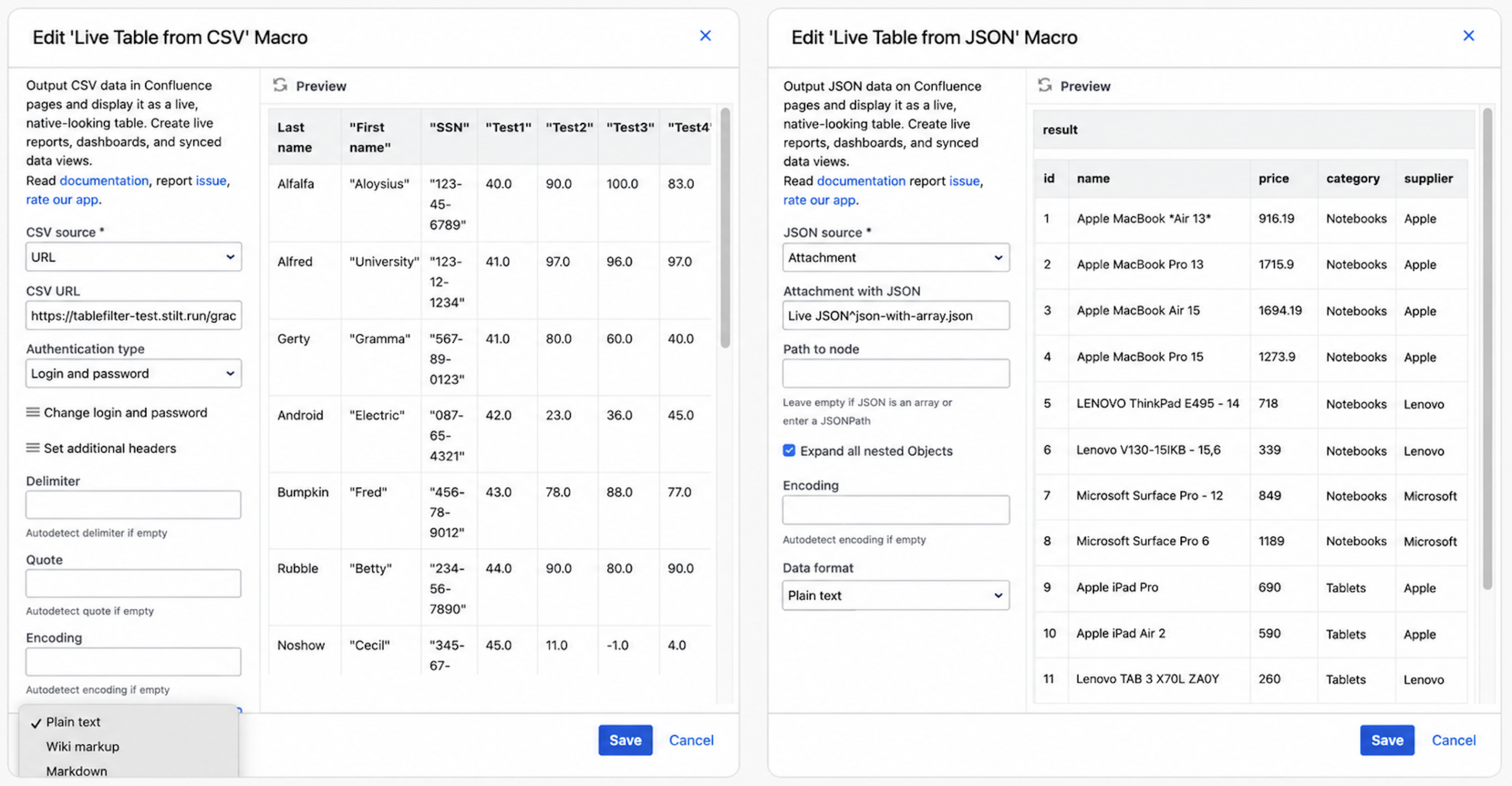
Live Tables from CSV & JSON for Confluence

Macro configuration – Live Tables from CSV & JSON for Confluence

External Data for Confluence

Best for: connecting multiple business systems to Confluence

External Data for Confluence is positioned more as an integration tool than a simple CSV/JSON importer.

Supported data sources: Salesforce, SharePoint, HubSpot, Airtable, Snowflake, SQL databases, and REST APIs.

It also includes advanced capabilities such as:

  • JsonPath parsing,

  • SQL-style filtering,

  • OAuth 2.0 authentication,

  • JavaScript transformations,

  • chart visualizations.

This makes it useful for cross-functional dashboards that combine customer, operations, and product data inside a single Confluence workspace.

For example, a customer success team could combine Salesforce account information with support metrics and display a shared customer health dashboard directly in Confluence.

Compared to lightweight CSV table apps, External Data for Confluence may require more configuration and technical setup. However, the broader integration capabilities can be valuable for organizations managing multiple business systems.
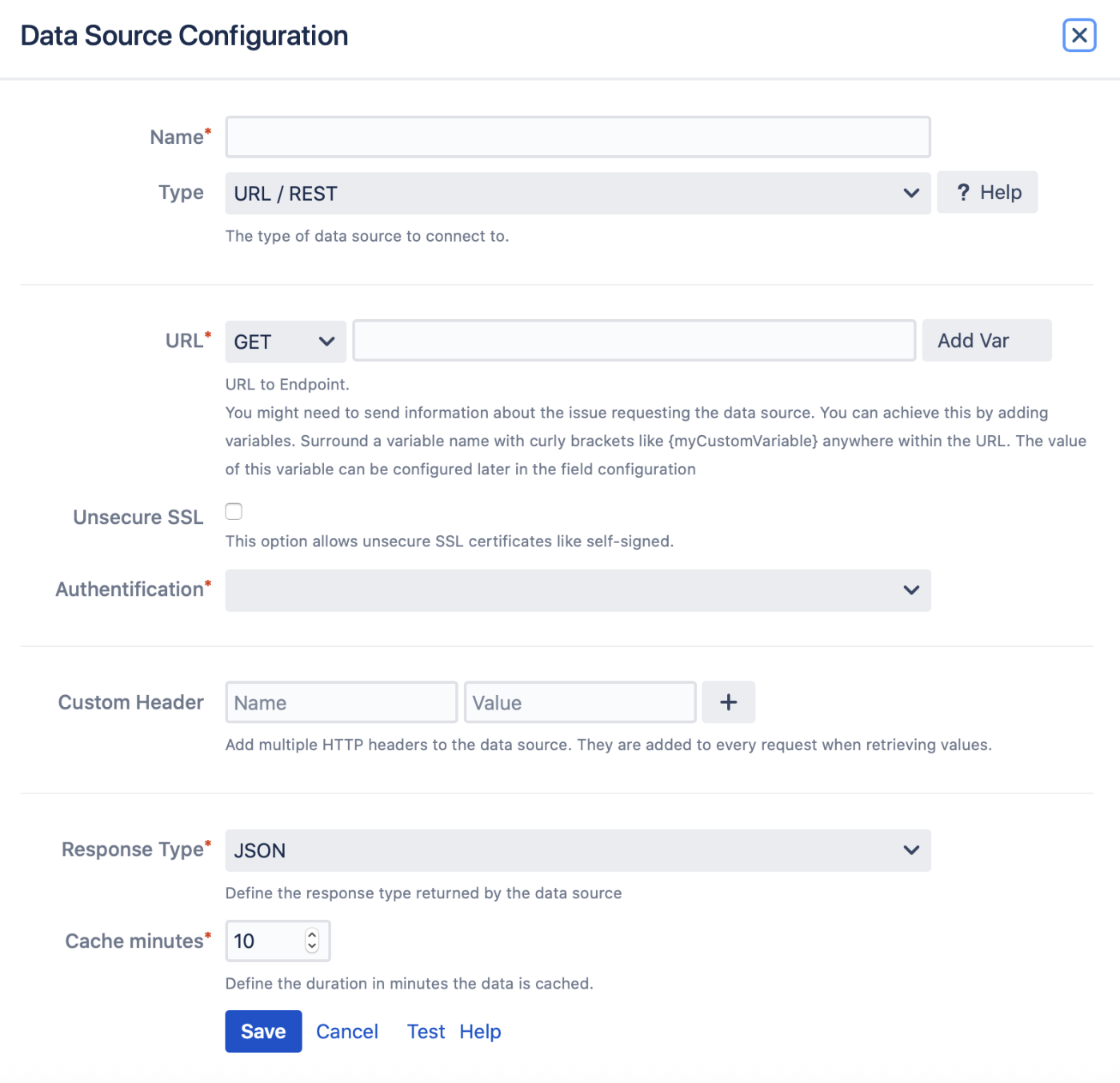
External Data for Confluence

Data source configuration – External Data for Confluence

eazyBI for Confluence Reports, Charts, and Dashboards

Best for: enterprise analytics and BI- style reporting

easyBI for Confluence Reports, Charts, and Dashboards is not mainly a table import app. It is closer to a full analytics and dashboarding platform for Confluence.

The app is relevant for automated external data synchronization and allows to import and analyze data from CSV/JSON files, REST APIs, SQL databases.

It also provides:

  • advanced dashboards,

  • drill-through reporting,

  • calculated metrics,

  • charting,

  • trend analysis.

eazyBI works particularly well when imported data becomes part of a larger analytics process involving multiple data sources and long-term reporting.

For example, organizations can combine Jira delivery metrics, operational KPIs, and financial reporting data into a centralized Confluence dashboard for leadership reporting.

It is powerful for enterprise-grade dashboards and advanced analytics inside Confluence.
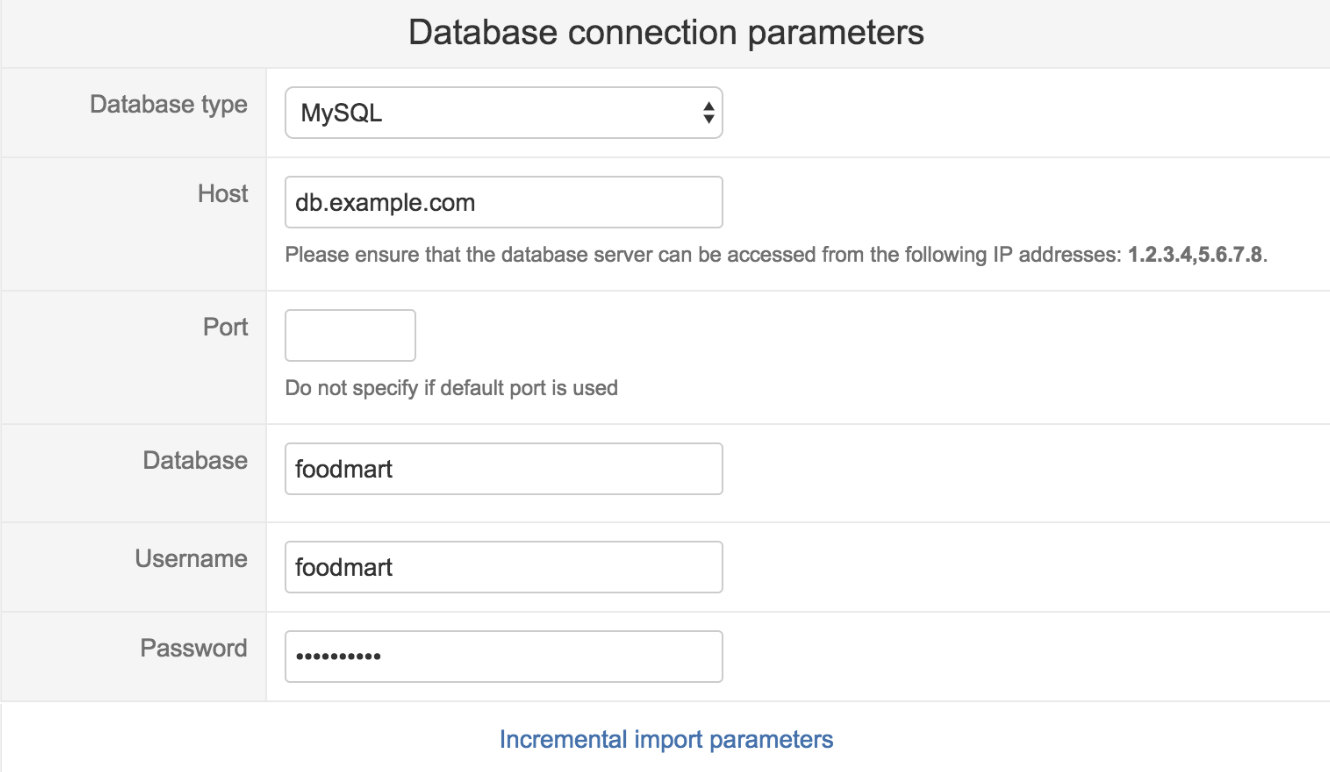
eazyBI for Confluence Reports, Charts, and Dashboards

 eazyBI database connection

Apps for interactive reporting and table analytics


Table Filter, Charts & Spreadsheets for Confluence

Best for: transforming imported data into dashboards and reports

Table Filter, Charts & Spreadsheets for Confluence is one of the most widely used reporting and table analytics solutions in the Atlassian Marketplace.

The app can display CSV and JSON attachment data as Confluence tables,

Furthermore, it creates Excel-like spreadsheets, applies formulas, builds charts, generates pivot-style reports, and filters and aggregates large datasets.

Its Table Spreadsheet macro also allows teams to upload and edit:

  • Excel files,

  • CSV files,

  • ODS spreadsheets.

For teams working with live external data, the app can be combined with the free companion Live Tables from CSV & JSON for Confluence app.

Using this combination, product managers can synchronize release metrics from Google Sheets and then use charts and pivot-style summaries to build release readiness dashboards for stakeholders.

This approach works especially well for operational dashboards and recurring reporting workflows where teams need both live synchronization and advanced visualization.
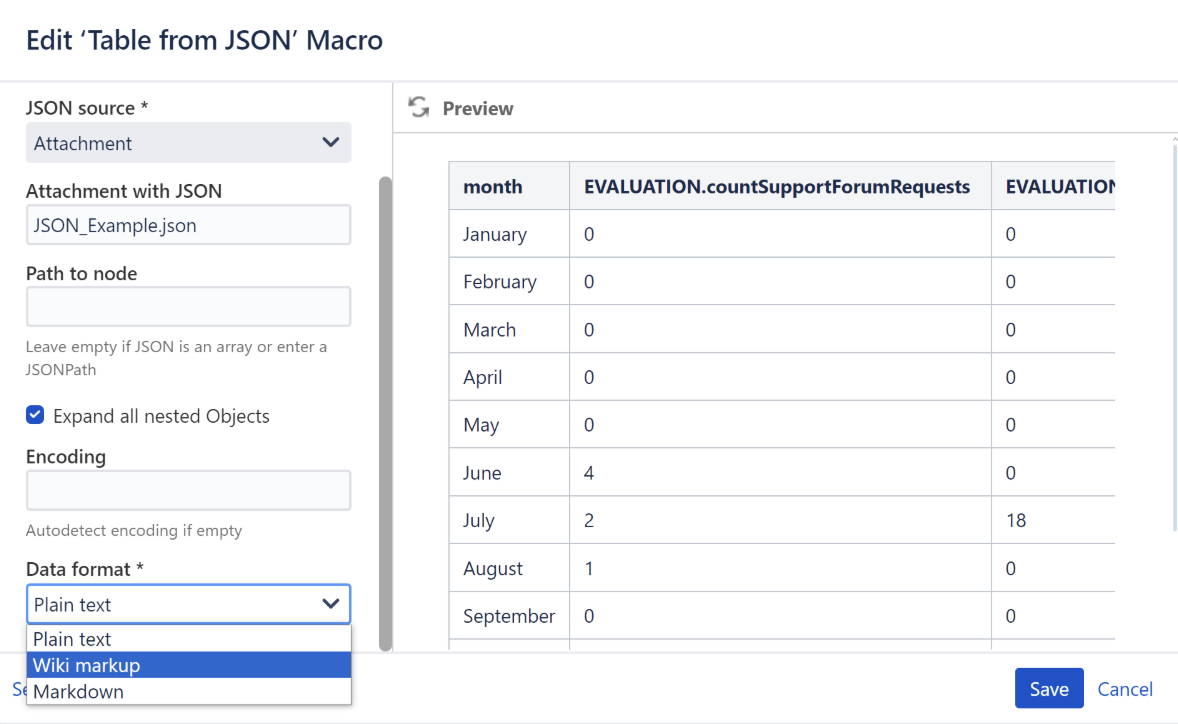
Table from JSON - Table Filter, Charts & Spreadsheets for Confluence

Table from JSON – Table Filter, Charts & Spreadsheets for Confluence

Advanced Tables for Confluence

Best for: improving table presentation and usability

Advanced Tables for Confluence focuses on making imported tables more interactive and easier to work with.

The app is positioned as a CSV and JSON integration solution. To import and display CSV or JSON data from attachments and external URLs, users can choose from the following macros:

  • CSV Table

  • JSON Table

It also offers additional table capabilities such as sorting, filtering, totaling, numbering, and custom CSS styling.

Unlike dashboard-focused analytics tools, Advanced Tables is more focused on improving the readability and usability of structured data directly on Confluence pages.

This makes it useful for teams that regularly publish operational or reporting tables and want better presentation and interaction options.
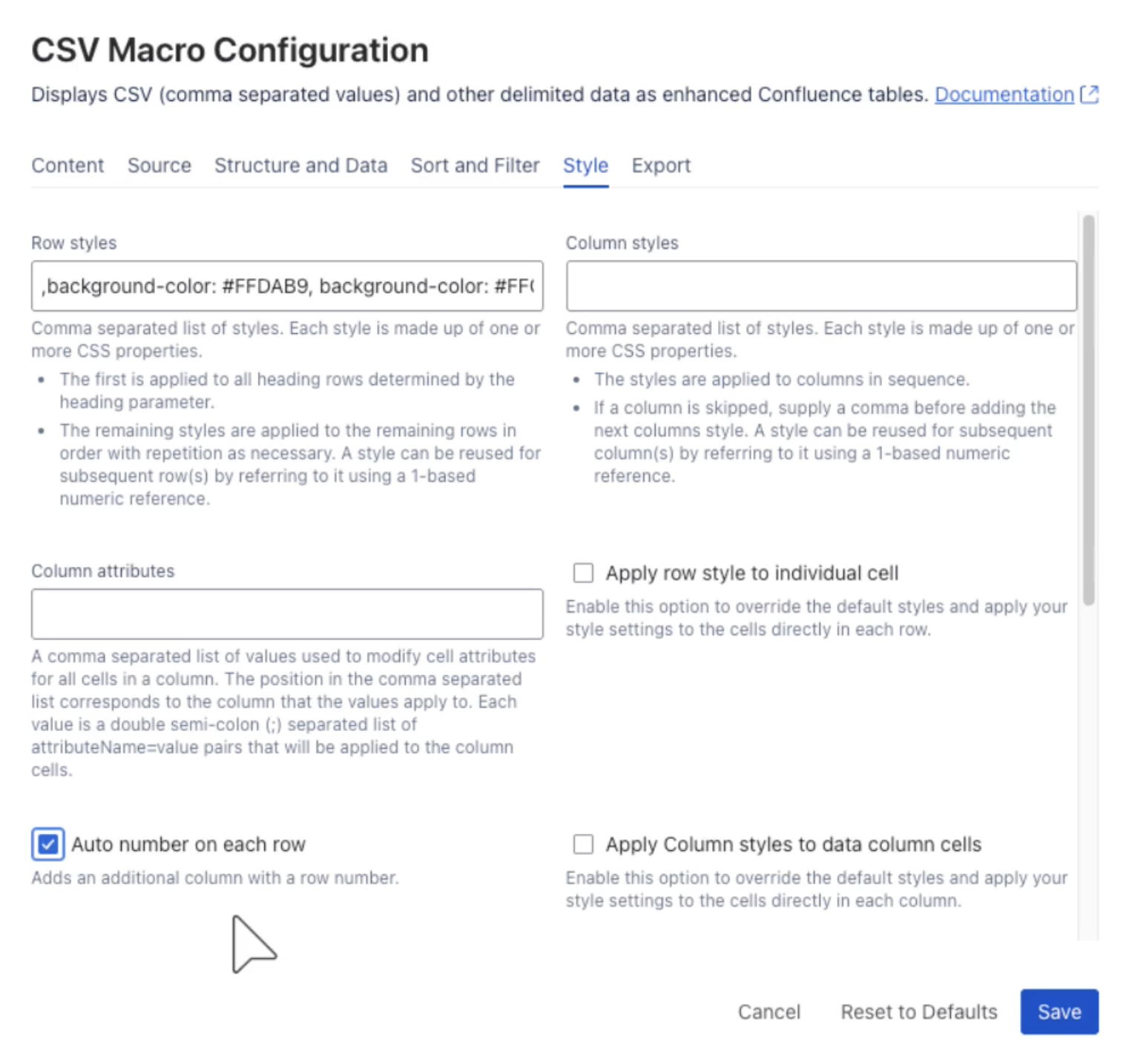
CSV macro - Advanced Tables

CSV macro – Advanced Tables

Data Tables for Confluence

Best for: navigating large CSV-based tables

Data Tables for Confluence helps users work more efficiently with large datasets embedded into Confluence pages.

The app works with regular Confluence tables, CSV data, a list of attachments, It can load CSV data placed in the macro body, from URL and attachments.

Its main strengths are usability features such as:

  • filtering,

  • grouping,

  • searching,

  • exporting,

  • interactive navigation.

Users who manage large infrastructure inventories or audit tables can make long datasets significantly easier to explore and review with this app.

Data Tables can upgrade CSV-based content into more interactive Confluence tables, but it is not positioned as a JSON import tool.
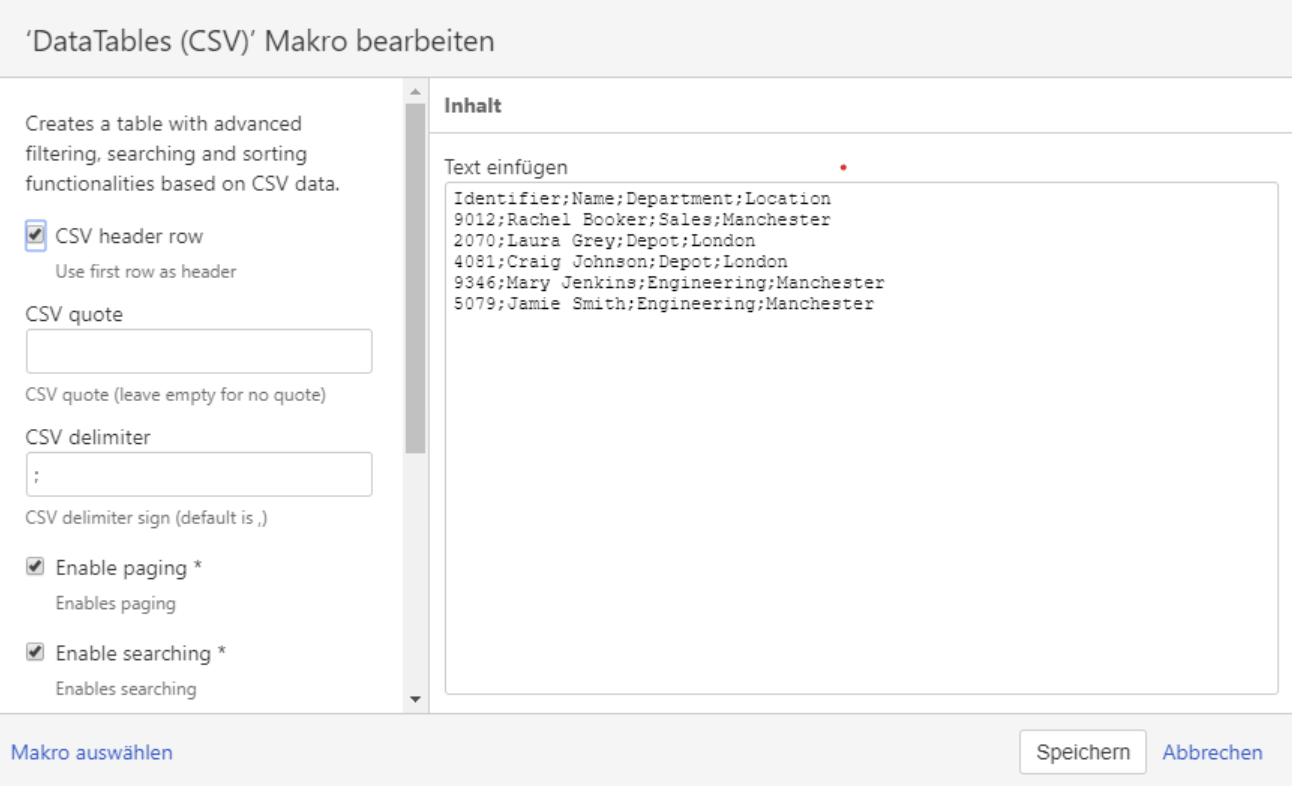
DataTables (CSV) macro - Data Tables for Confluence

 DataTables (CSV) macro – Data Tables for Confluence

Apps for simple CSV display


Csv To Table for Confluence

Best for: quick CSV-to-table conversion

Csv To Table for Confluence keeps the workflow intentionally simple: it turns CSV data into a sortable Confluence table.

The app converts CSV content from:

  • attachments,

  • URLs,

  • pasted/raw content.

Its narrow scope can actually be an advantage for organizations that only need lightweight CSV visualization without advanced reporting features or configuration.
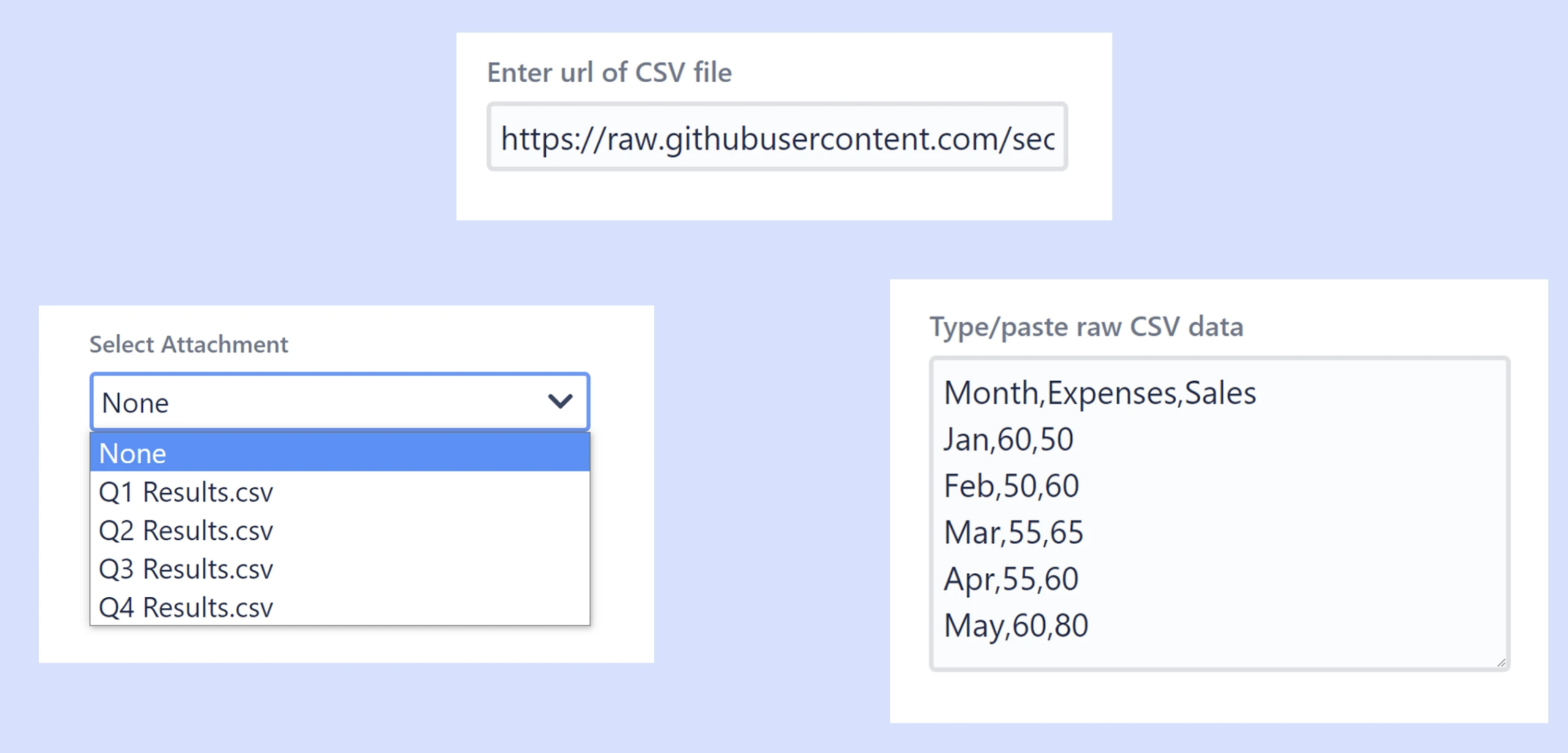
Data Import - Csv To Table for Confluence

Data Import – Csv To Table for Confluence

Table from CSV in Confluence

Best for: improving readability of CSV files

Table from CSV in Confluence displays attached or remote CSV files as readable Confluence tables

The app has small but useful features:

  • search through the table,

  • sort columns by clicking headers,

  • scroll through wider datasets,

  • links display,

  • markdown-style formatting.

It works well when organizations already manage operational data in CSV files and simply want a better viewing experience inside Confluence.
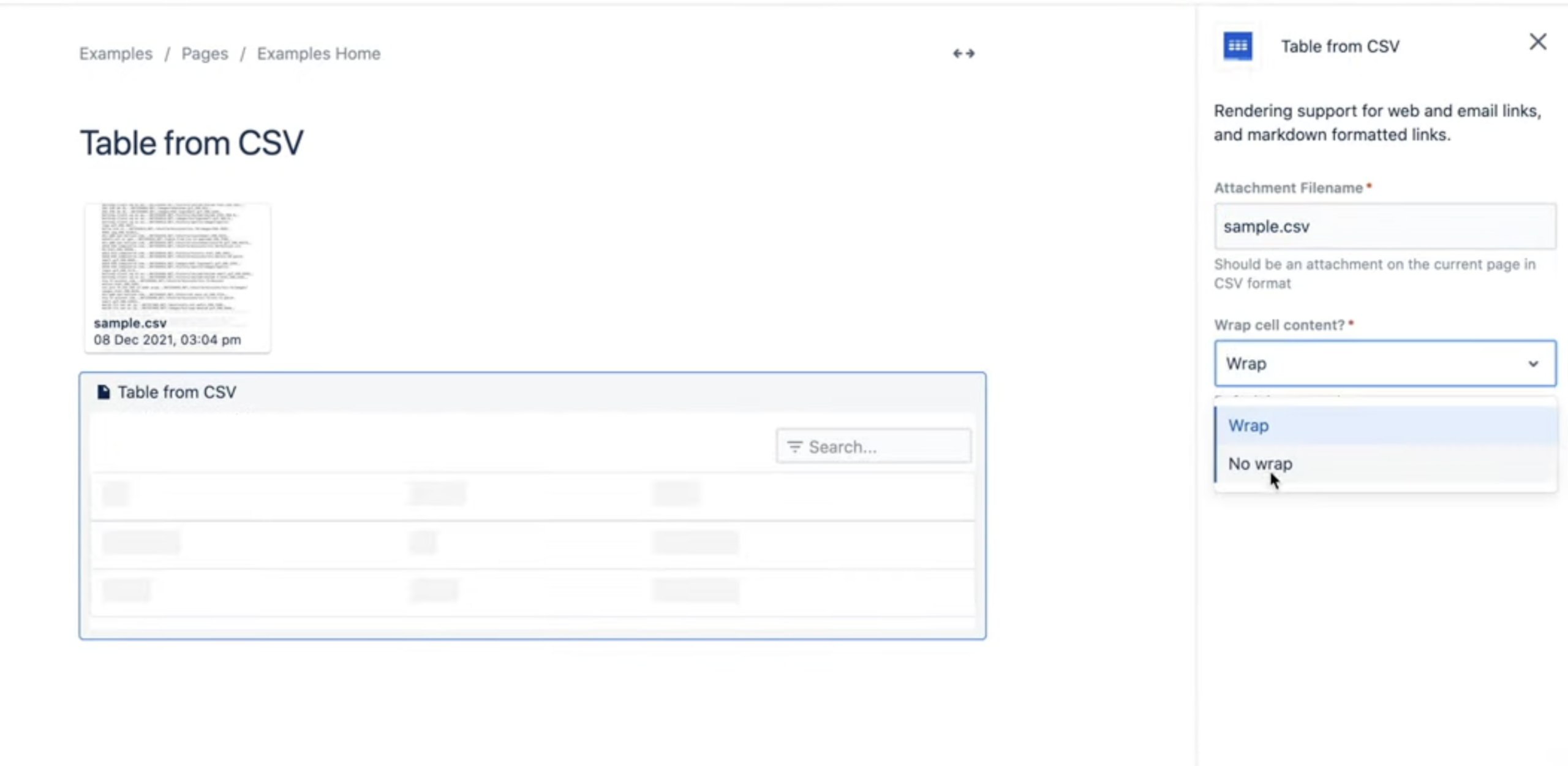
Table from CSV in Confluence configuration

Table from CSV in Confluence configuration

CSV File To Table for Confluence

Best for: simple CSV table rendering

CSV File To Table for Confluence converts CSV files into tables in Confluence.

The app can display CSV files uploaded from their desktop or stored as Confluence page attachments.

It has basic navigation options such as search, sorting, pagination.

This makes it a practical option for organizations that periodically upload reporting CSV files and mainly need a clean presentation layer.
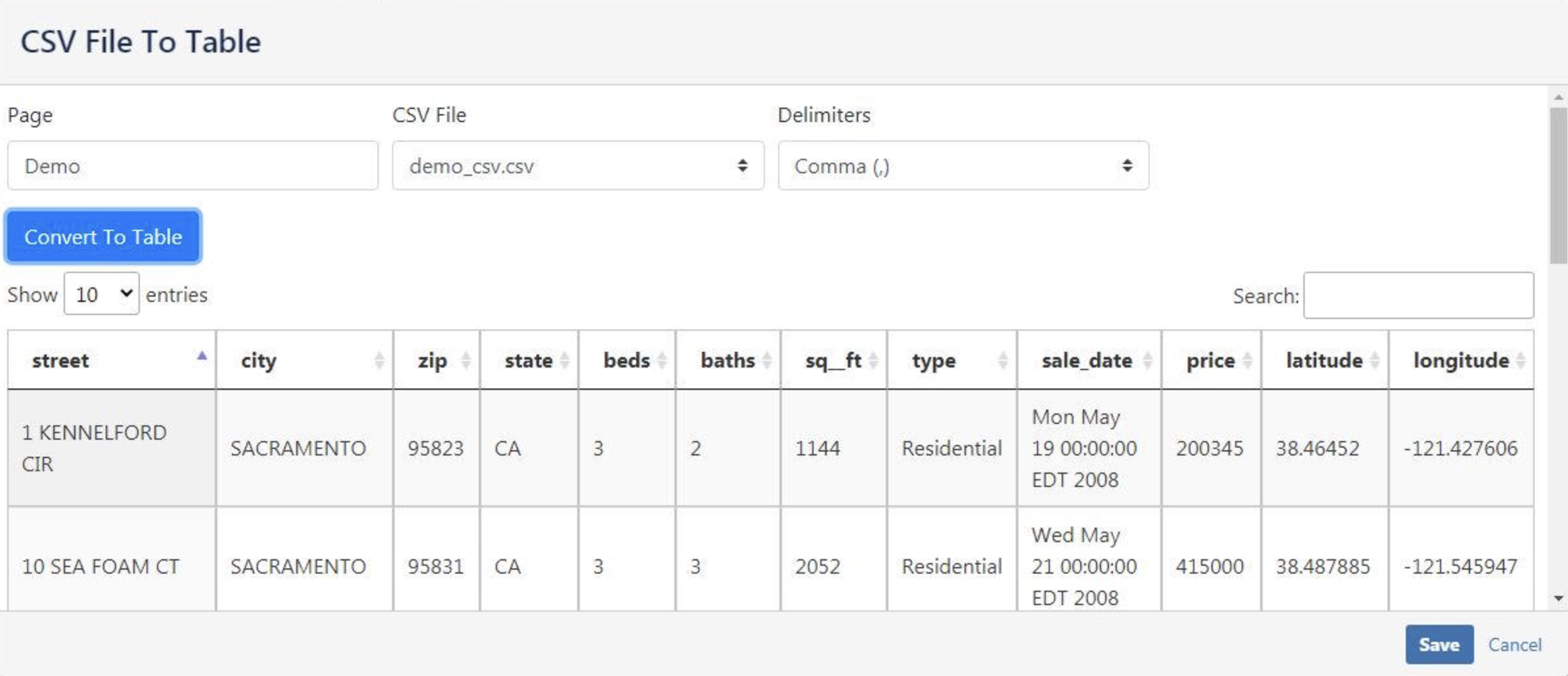
CSV File To Table macro browser

CSV File To Table macro browser

Smart Tables for Confluence

Best for: inline editing for CSV and excel- based tables

Smart Tables for Confluence focuses on editable table workflows inside Confluence pages and can import Excel and CSV files.

It is better suited for manually maintained datasets where teams periodically refresh uploaded files rather than connect live external sources.

For example, internal operations teams can maintain shared inventory or planning tables collaboratively without leaving Confluence.

The app has the inline table editing feature, so users can adjust and organize data in the page view mode. Real-time updates can also help teams maintain shared tables where several people contribute to the same dataset.
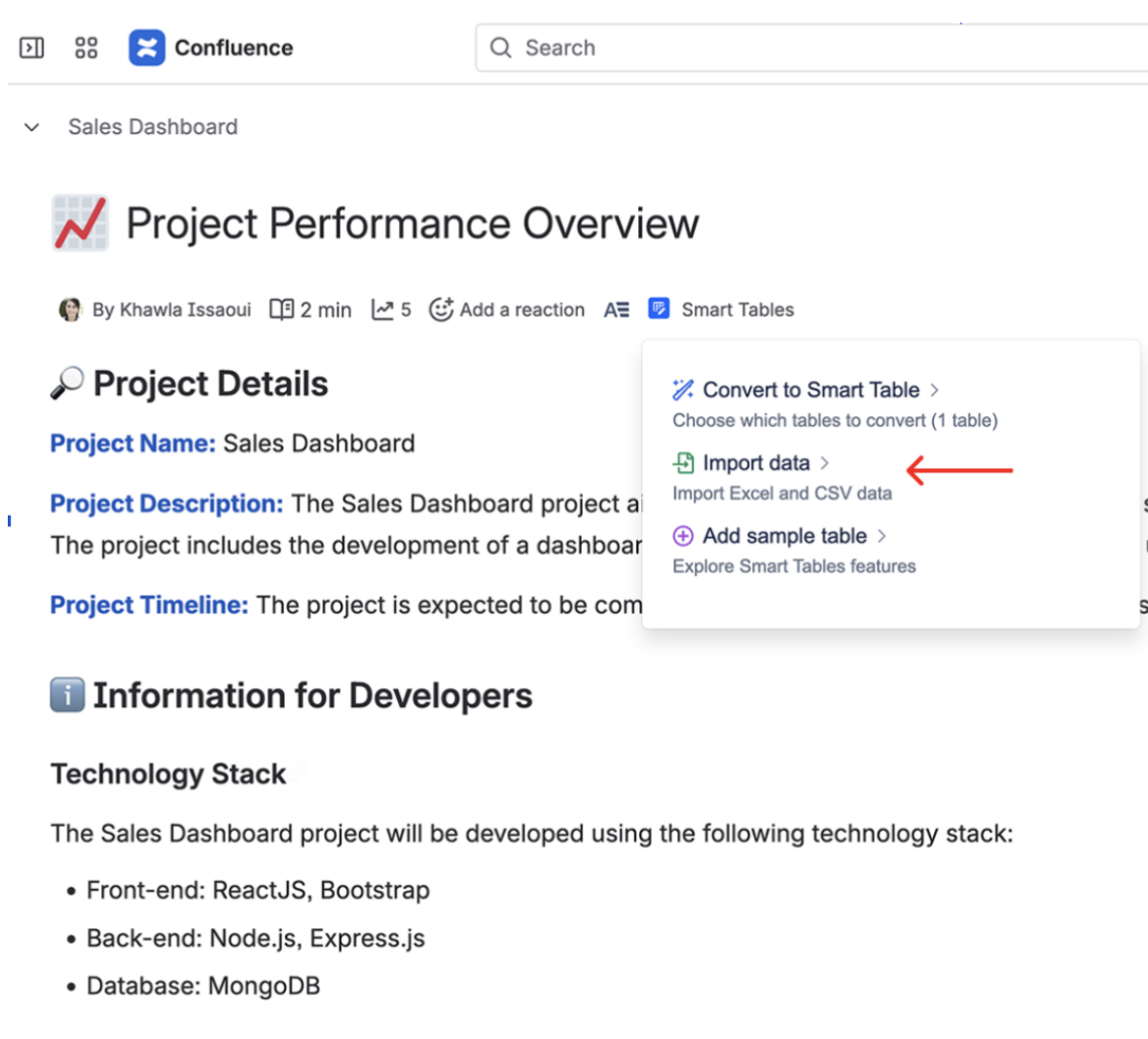
CSV Import - Smart Table for Confluence

CSV Import – Smart Table for Confluence

Which type of app fits your use case?

Different teams require different capabilities.

  • Lightweight CSV viewers are best for simple CSV-based tables with minimal setup.
  • Interactive reporting tools are suitable for dashboards, large datasets, and advanced filtering, charting, or spreadsheet-style calculations.
  • Live integration solutions are designed for teams that rely on APIs, Google Sheets, or other external sources and need automatically updated reports.
  • BI platforms are ideal for combining multiple data sources, analyzing trends, and supporting enterprise reporting.
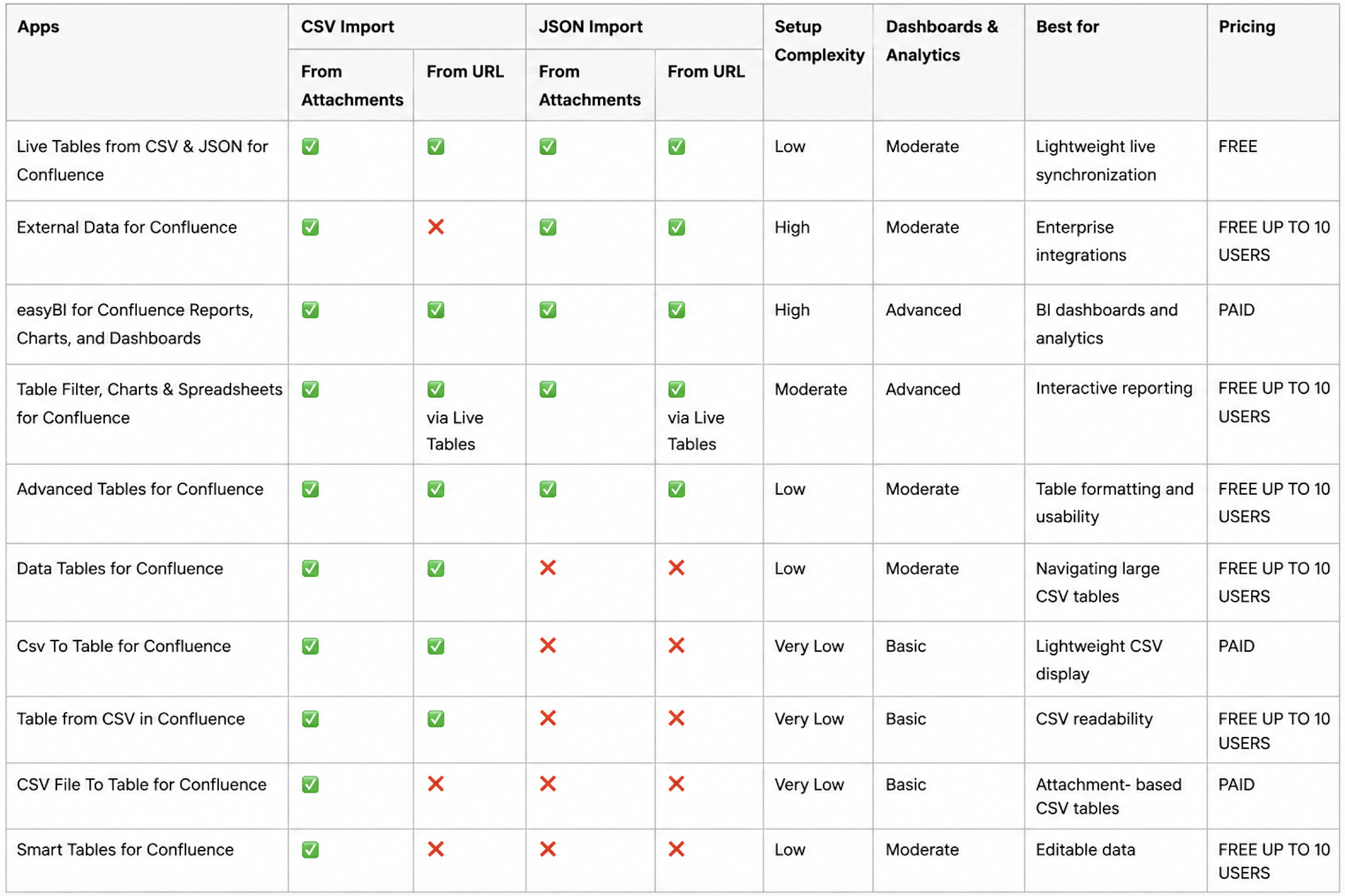
Live Tables from CSV & JSON for Confluence

Feature Comparison Table

Final thoughts

As Confluence Cloud becomes increasingly connected to external systems, live data integration is quickly becoming a standard expectation rather than an advanced capability.

Organizations increasingly want:

  • dashboards that stay updated automatically,

  • reporting based on real operational data,

  • and workflows that reduce repetitive manual updates.

Fortunately, Confluence Cloud users already have several practical options available today – from lightweight CSV viewers to advanced analytics platforms and live synchronization tools.

The best choice ultimately depends on how your organization works with data: whether you only need readable tables, interactive reporting, or fully connected operational dashboards.

Even small improvements in how teams synchronize external data can significantly reduce manual reporting work, improve visibility across projects, and help Confluence pages stay trustworthy over time.

FAQs

Can Confluence Cloud import CSV and JSON data?

Yes. Several Atlassian Marketplace apps allow users to display CSV data from attachments, URLs, or external systems directly on Confluence pages.

Can Confluence Cloud display JSON data?

Yes. Apps supporting JSON import include Live Tables from CSV & JSON for ConfluenceExternal Data for ConfluenceeasyBI, and Advanced Tables for Confluence.

How can I automatically update CSV/JSON data in Confluence?

Instead of manually uploading files, some Atlassian Marketplace apps can synchronize data from URLs, APIs, Google Sheets, and other external sources.

Which app is best for dashboards and reporting?

For advanced filtering, charting, and reporting, teams commonly use Table Filter, Charts & Spreadsheets for Confluence or easyBI for Confluence Reports, Charts, and Dashboards.

Atlassian System of Work: why Confluence is becoming the center of teamwork

April 14, 2026
#Project management#Confluence#Collaboration
16 min

Atlassian System of Work: Jira is no longer ‘just for developers’

For almost 2 decades, the general public associated Atlassian software only with Jira. ‘It’s something that software developers use at work.’ Something hard to understand, let alone use. If you weren’t writing code, you probably assumed it wasn’t for you.

Today, that mental model is out of date. Just look at how they support the Williams F1 team or how they advertise themselves on their own website. There’s no more world revolving around one product – there’s Atlassian as a whole.

Atlassian System of Work: products become Collections
Atlassian products become Collections. Source: atlassian.com homepage

​After years of developing and talking about individual products, the story naturally morphed into a cohesive System of Work – a comprehensive platform that can be tailored to every customer and connect different teams, goals, and workflows. Atlassian is no longer selling ‘project tracking for software development’, but rather a place for everyone inside the company.

This new philosophy is centered around four ideas:

  • align work to goals,
  • plan and track together,
  • unleash collective knowledge,
  • realize the full power of AI teammates.

And it’s not just a fantasy, but rather a direct response to what’s happening in the market. Atlassian has always been good at spotting the big trends and capitalizing on them.

According to Flexera’s newest IT Priorities Report 2026, 87% of IT decision-makers are moving away from point tools and consolidating into platforms to improve visibility and governance across their organizations.

According to Flexera’s newest IT Priorities Report 2026, 87% of IT decision-makers are moving away from point tools and consolidating into platforms to improve visibility and governance across their organizations.
Source: Flexera

​The shift from a bunch of products to a connected platform aligns with the customers’ rising expectations from their Jira, Confluence, and Marketplace apps. So we should throw away the old assumption that ‘Jira is for developers,’ as if everyone else should work elsewhere.

But this shift also gives us a new balance of power among the different tools within this larger whole.

Confluence as a core workspace for every team

Since their IPO in 2015, Atlassian has been unleashing the potential of every team. According to last year’s Q2 Shareholder Letter, Jira’s technical vs. business user diversity is roughly 52/48, Jira Service Management is 51/49, and Confluence is exactly 50/50.

It took them 10 years to finally overcome the old perception and achieve a perfect split!

A year later, an update confirms that 50% of Atlassian’s users are in finance, HR, marketing, and other non-technical teams. It’s not a prediction anymore – it is a fact, already visible in the numbers.

50% of Atlassian’s users are in finance, HR, marketing, and other non-technical teams. This makes Confluence a core workspace for every team increasingly more than Jira.
Source: Atlassian

​Most of these users are new to the game and don’t know what was going on 5-10 years ago. They bring totally different ways of working and information needs to the software they use. Their universe consists of text, multimedia, and tabular data rather than code and workflows. They might use Jira for planning and tracking, but Confluence is where their work actually happens.

For them, moving the cards around on a Kanban board is one of the most boring and mundane things to do. For them, work is the artifacts, data, discussions, and decisions.

This mindset makes Confluence much more than a documentation dump or a knowledge base. Now, it’s a living space where these teams spend most of their working time. This means a totally different logic of how they approach using the Atlassian tools.

A live comment about Jira we got from a user on a recent The Jira Life episode

Atlassian Teamwork Collection flips the table for Jira

The Atlassian State of Teams 2025 report showed that 40% of knowledge workers have their direct collaborators in a different job function. For cross-functional teams, a shared context is gold, most of which lives outside their Jira projects. Jira solves for ‘who’s doing what and when’, but what’s actually getting done (deliverables), how it’s getting done (documentation), and the outcomes live elsewhere. Other players in the market also see this and make similar moves: there are Monday Workdocs, Slack canvases, etc., etc., etc.

In Confluence Cloud, there are pages, live docs, whiteboards, and databases, coupled with a powerful search engine and the ability to embed content from many other tools and sources. All this makes it an ultimate workspace for team collaboration, live documentation & knowledge sharing – not just a static ‘wiki’ that everyone hates to log into. That’s why we see customers of all sizes repeatedly having more seats in Confluence than in Jira. Even when only a small portion of users actually create new content, the rest benefit greatly from access to it and the ability to search for or pull information with Rovo.

Rovo: the game changer

Yeah, that’s right. There’s also Rovo in the mix now.

It’s the reason why Atlassian now describes Jira as merely ‘the system of record for work’, while Confluence is ‘the workspace where human and AI teammates can collaborate together.’ Rovo enables this collaboration by pulling context from both Atlassian and connected third-party tools right into the teams’ content and workflows.

Aligning work with goals, planning and tracking together, or realizing the power of AI teammates is impossible without first unleashing collective knowledge. Both humans and AI do better when information is shared, structured, and connected. Confluence is the place designed to store and work with that information – that’s why it becomes more important than ever.

The idea of connecting different teams across the company on a single platform really resonates with us at Stiltsoft.

Atlassian Teamwork Collection: AI doesn’t work without a high-quality underlying context
AI doesn’t work without a high-quality underlying context. Source: Deiser

Bring everyone on the same page in Confluence: the key to effective collaboration

Yet, there’s still a lot of work to do until we can fully realize the potential of a unified platform.

The average knowledge worker spends 25% of their time looking for the information they need to do their work. That’s 2 hours a day.

SaaS portfolios are getting leaner as companies consolidate, but an average team still uses 11 apps every single day. Half of the workers can’t find what they need across all of them, so they ask people on Slack or book calls – even for something simple, like a project status.

According to the State of Teams 2025, 50% of leaders say their teams unknowingly work on the same things, and only 20% feel confident they have an effective process to quickly inform other teams of decisions that may impact their work.

This doesn’t sound surprising with such a level of data fragmentation. Here’s our take on how we can fix it.

Finance, human resources, marketing, IT, project management office, and leadership – they all need to access reliable data right where they meet and work together. Bringing information from various sources into Confluence, combining it there for analysis, and presenting it in a visually appealing way helps reduce silos and makes up-to-date knowledge available to both people and AI.

In turn, this will allow teams:

Confluence can become the source of truth for insights and decisions. To unlock this, teams need to build interactive content using data from across spaces and other connected tools. This will literally keep everyone on the same (Confluence) page!

How to use Confluence and Jira together: from planning to reporting

‘But what about Jira? There are already dashboards in there that we use a lot.’

Jira dashboards contain the data that teams report on and can share with their stakeholders. But not everyone’s a Jira user, and there are ‘haters’ among senior leaders who create a separate folder in their inbox to store Jira notifications and never open them.

Also, there’s no way to add more context, comments, or feedback to these dashboards. As a workaround, teams take screenshots or export data to Excel for presentation elsewhere. This workflow causes information to become outdated before the meeting even starts, as the link to the data source gets untied. Users have to manually update such reports, which is tedious, time-consuming, and error-prone.

We prefer interactive, dynamic, and customizable Confluence pages that contain Jira data instead. For example:

  • Add an overview of the in-progress and completed tasks associated with each project on its corresponding Confluence page.
  • Create a Gantt roadmap on a Confluence page that shows deadlines and milestones for a product release, development project, or marketing campaign.
  • Categorize work items in a filter based on status, priority, assignee, labels, or a custom field.

In Confluence, teams can dig into these views, ask questions, add comments, and provide feedback. The leadership can see the data along with this additional context in one place.

In Confluence, teams can dig into Jira data views, ask questions, add comments, and provide feedback. The leadership can see the data along with this additional context in one place.
Not every data-related discussion has to be a meeting anymore!

Summary: Jira and Confluence -> Atlassian System of Work

If you still picture Atlassian as ‘tools for developers,’ you’re looking at an old photograph. The numbers, the product roadmap, and the way customers actually work all point in the same direction: the System of Work now spans the entire organization, and Confluence is moving into the center of that picture.

Jira will remain the backbone for tracking work, but it’s no longer the only place that matters. Confluence is where cross-functional teams share context, surface findings, discuss trade-offs, and record decisions – and where AI teammates can work with knowledge that isn’t buried across dozens of tools.

For vendors, partners, and customers alike, this creates a huge opportunity: stop treating Confluence as a static knowledge base and start treating it as the place where work actually happens. When you bring more data and analysis capabilities to Confluence pages with an app like Table Filter, Charts & Spreadsheets for Confluence, you’re not just making nicer reports. You’re helping teams see the same picture, in the same place, at the same time – and that’s what the System of Work is really all about.

As the Atlassian Ecosystem is extending far beyond tech teams, we already have some of those newcomers as our customers, and we’re welcoming more to join in the future.

Table Filter, Charts & Spreadsheets for Confluence

FAQ

What is the Atlassian System of Work?

The System of Work is Atlassian’s name for a connected way of running an organization across its tools. Instead of treating Jira, Confluence, Loom, and Rovo as isolated products, Atlassian positions them as parts of one operating model built around four ideas:

  1. Align work to goals – connect everyday tasks and projects to clear business outcomes.
  2. Plan and track work together – keep everyone on the same page about who’s doing what and when.
  3. Unleash collective knowledge – capture and share the information, decisions, and lessons that usually stay in people’s heads or scattered tools.
  4. Realize the full power of AI teammates – use AI agents that can actually understand your work because they’re plugged into your tools and knowledge.

In this model, Jira is the system of record for work, where issues and workflows live. Confluence is the collaborative workspace where teams write, explain, discuss, report, and structure knowledge for both humans and AI. Together, they form a unified platform for every team, not just a project tracker for developers.

What is Atlassian Teamwork Collection?

The Atlassian Teamwork Collection is a bundled offering that packages together the core tools needed for modern collaboration across technical and business teams. While the exact composition can vary by offer and partner, it typically includes:

  • Jira for planning and tracking work,
  • Confluence as the collaborative workspace,
  • Loom for async video communication,
  • and AI capabilities / agents (Rovo) to help teams find and act on information.

From a customer perspective, Teamwork Collection is a signal that Atlassian isn’t just selling individual products anymore. It’s selling a unified system for teamwork: one place where work is planned, documented, discussed, and reported on – with AI layered across all of it.

Atlassian’s data shows that 50% of users are in finance, HR, marketing, operations, and other business roles. Teamwork Collection is explicitly designed with those teams in mind.

Is Confluence a project management tool?

Confluence is not a project tracker, but it is the workspace where projects actually come to life.

Think of the split like this:

  • Jira:
    • Tracks tasks, epics, sprints, workflows
    • Answers “who’s doing what and when?”
    • Holds structured work items and status data
  • Confluence:
    • Stores project briefs, plans, specs, roadmaps, decisions, and summaries
    • Answers “why are we doing this, what’s the context, and what did we decide?”
    • Holds deliverables, documentation, reports, and the team’s knowledge

On its own, Confluence isn’t a full-blown project management system. But together with Jira, it becomes the place where:

  • Project goals, timelines, and risks are explained
  • Jira data is turned into readable, visual reports
  • Stakeholders comment, ask questions, and align around the same source of truth

With an app like Table Filter, Charts & Spreadsheets for Confluence, teams can add Gantt-like roadmaps, status overviews, and live dashboards directly to Confluence pages. That makes Confluence feel much more like a project management workspace, especially for non-technical teams that prefer pages and tables over Kanban boards and backlogs.

Can Jira be used for non-software projects and teams?

Yes. Jira is already heavily used by non-software teams, and Atlassian’s own numbers confirm it. According to the Q2 FY26 shareholder letter, about 50% of Atlassian users work in finance, HR, marketing, and other non-technical functions.

For non-technical teams, Jira works well when you:

  • Model your work as a structured framework (requests, tasks, approvals, campaigns, etc.).
  • Configure workflows that match your real process (e.g., draft → in review → approved → launched)
  • Use boards, backlogs, and fields to track priorities, owners, and deadlines

Practical non-software use cases include:

  • Marketing: campaign backlogs, content production, launch plans
  • HR: hiring pipelines, onboarding tasks, policy rollouts
  • Finance & ops: month-end close tasks, procurement, vendor requests
  • PMO: cross-project tracking, risk logs, portfolio views

Where non-technical teams often struggle is reporting: default Jira dashboards can feel too “inside baseball,” especially for stakeholders who don’t live in Jira every day. This is where Confluence comes in – as the place to build understandable, visual, narrative reports using Jira data.

How do Confluence and Jira work together?

Jira and Confluence are designed to be used together – Jira as the execution engine, Confluence as the connected collaboration and reporting layer.

Linking work items and pages

  • Create a Confluence page for a project brief, spec, or report.
  • Insert or link relevant Jira issues, epics, or filters directly into the page.
  • Readers can drill into the details from Confluence without switching tools.

Reporting in Confluence using Jira data

    • Use the Jira work items macro to pull live Jira data into Confluence.
    • Build interactive tables, charts, and overviews that update automatically as Jira changes.
    • Avoid screenshots and manual exports to Excel that quickly become stale.

Context + commentary in one place

  • Jira holds the structured data (status, assignee, dates).
  • Confluence holds the narrative (why we’re doing this, what changed, what we decided).
  • Stakeholders comment and ask questions on the page that contains both.

Dashboards for non-technical stakeholders

  • Many leaders and business teams dislike living in Jira, but they still need visibility.
  • A Confluence “hub page” per initiative, team, or portfolio can show:
    • status summaries,
    • key Jira metrics and charts,
    • links to deeper reports,
    • and decision logs.

Apps like Table Filter, Charts & Spreadsheets for Confluence enable you to turn Jira-powered tables into filterable dashboards, pivot reports, and visual charts right on the page. This way, teams don’t have to export data to Excel or Google Sheets – they can analyze and present it directly in Confluence.

Confluence Page Status Management

January 16, 2024
#How To#Project management#Confluence Tutorial#Reporting#Confluence#Case Study#Collaboration
10 min

Today, Confluence is widely used by many diverse teams for seamless collaboration and documentation management. This highly customizable tool facilitates knowledge sharing, project management, and effective communication. So, let’s dive into the typical workday filled with working with Confluence Cloud and see how Confluence page status management can enhance it.

Product and Content Managers: Challenges, Tips, and Tricks

To start, meet Betty and James, colleagues and Confluence Cloud enthusiasts who love to discuss their work and challenges during the coffee breaks. Despite working in different departments (Content and Product Management), their Confluence work organization challenges are alike. They both strive to find better ways to communicate their work status to their colleagues or indicate when the piece is ready to see the world. Whether it is the latest release or K-Base article, Confluence Page Status opportunities can help in both cases. It turns out that taking coffee breaks with colleagues has its perks and this time, the benefit is the discovery of the Handy Page Status macro from Handy Macros for Confluence app, which can save the day in case of fear of writing blog posts and planning multiple releases.

This article covers tips and tricks on how to set expectations for viewers and collaborators and locate required data in a heartbeat while on the Confluence page. See what James and Betty have learned on their journey and what highlights they had on the way. From how to indicate the Confluence documentation status to putting the Confluence Page Status data in custom reports to filter and search by it – all covered in the reading below!

Learn the Basics: Confluence Page Status

First, what is Handy Page Status, and what value does it bring to the table to the Confluence Page Status? Let’s say ideas are notes, Confluence is a sheet of music that fellow collaborators and viewers can review, and the music symphony is ready for collaboration and feedback. How can we keep everyone on the same music sheet and signal that the symphony was born? The simple solution is to customize and incorporate page status management that best serves your company’s needs.

So, Confluence Page Status is a game-changer for teams and professionals who:

  • Need to incorporate straightforward, accessible, and reusable tools that ensure transparency and clarity of the workflows and their timelines.
  • Deliver dynamic work exposed to active feedback or used immediately as a reference (Betty’s Example: Latest How-To K-Base Article; James’ Example: Content of 1.3.20 app release version).
  • Want to get control of the workflow and its lifecycle and make sure that the feedback is given on the specific timeline of which everyone is aware (Betty’s Example: Page Status: Under Review James’ Example: Page Status: 1.3.20)

Learn About Advanced Status Management: Handy Page Status

With Handy Page Status, both Betty and James can go the distance and level up their Confluence Page Status experience, In addition to native functionality, this macro can:

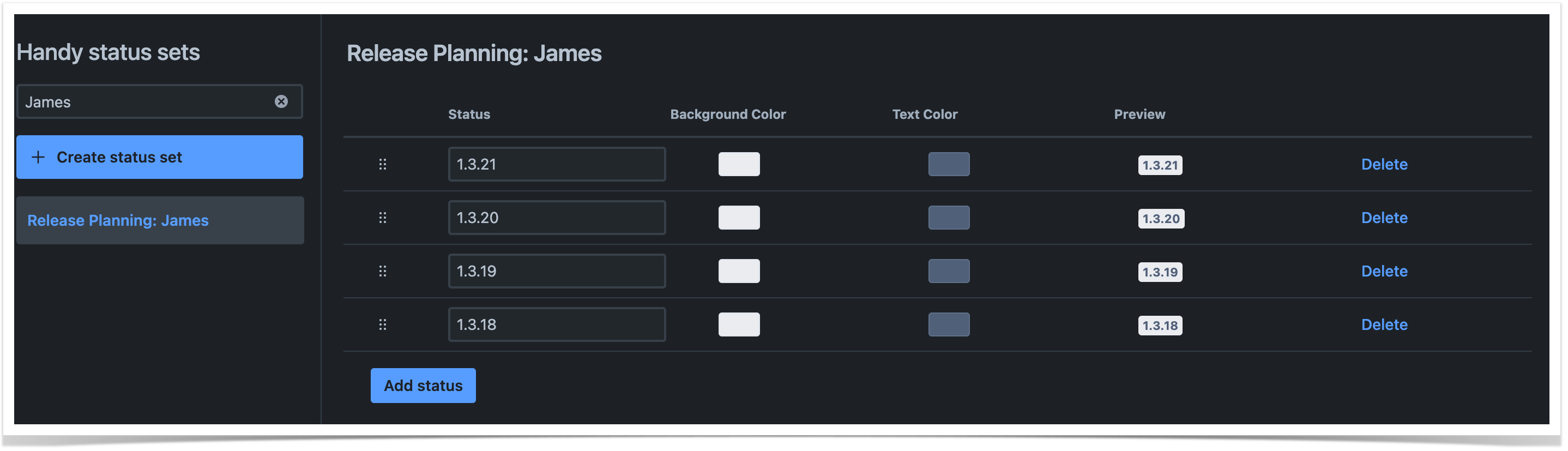
  • Create status options that work best for your company process and reuse these status sets across pages for status consistencyJames’ and Betty’s works are often parallel lines. Still, they benefit from each other’s Handy Page Statuses. James, assign each Confluence page with the bug report or feature request overview with the corresponding app version when it is planned to deliver them. Betty knows she needs the How-To Article in the blog ready precisely on the release date. All thanks to James’ Handy Page Status for Release. So she knows it’s safe to have the article in the ‘IN PROGRESS’ stage rather than ‘OPEN TO FEEDBACK.’
  • When making updates in one click, also see the update history.  The Handy Page Status history can help teams identify bottlenecks and encourage action. Maybe it’s time for another R’n’D session if the same bug fix has been postponed for three consecutive app versions. History also supports tracking time and seeing if Betty is in timing while changing her content from status to status.
  • Search and filter for specific page statuses and have a big picture of custom data in the form of the Handy Page Status Reports. Betty can create a custom report with a specific ‘READY FOR REVIEW’ status for selected spaces to signal feedback givers the article’s status before it goes live and public. James can review at a glance what will be released in version 1.3.20. It helps him decide whether the release can be locked, and the team can proceed with the following steps.

Boost Content Marketing and Product Management in Confluence

And now, here is an example solution. We will see how James and Betty put the Handy Page Status and Handy Page Status Report into practice. They immediately ace their daily workflows and relieve the pain that hits the nerve.

The solution only requires three easy steps:

  1. Сreate a new status set that reflects your needs.
  2. Have the time of your life assigning statuses to all relevant pages.
  3. Benefit from the Page Status Report to search and filter Confluence pages and have all the critical information ready at one glance.

Minimalistic Dark Mode Lovers – we’ve got you covered!

Minimalistic Dark Mode for Page Status Report

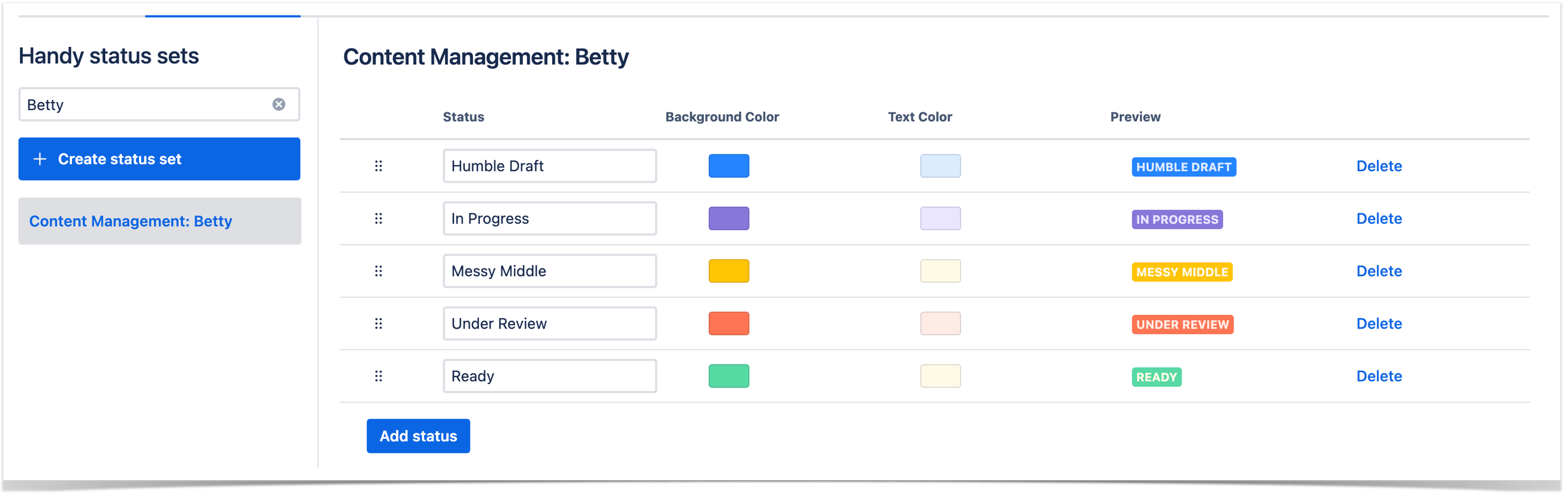
For those who live on the bright side, Handy Macros for Confluence has a variety of colors to choose from and play with!

handy status colors

Organize Confluence Page Status Data into Reports 

Those steps look easy enough. Still, they remain to be an effective tool for page status control. The Handy Macros for Confluence app has even more to offer, from Confluence dark mode support to multiple reporting criteria.

The data can be collected in a separate Handy Page Status report based on:

  • Confluence spaces where the status is set
  • Handy Page Status sets
  • Handy Page Status options
  • Confluence users who set the status
  • Handy Page Status dates

Handy Page Status report

Now it’s time to review how it goes on Confluence pages. We will see how you can track release versions and indicate content creation progress in Confluence Cloud.

Control App Releases: James’ Case

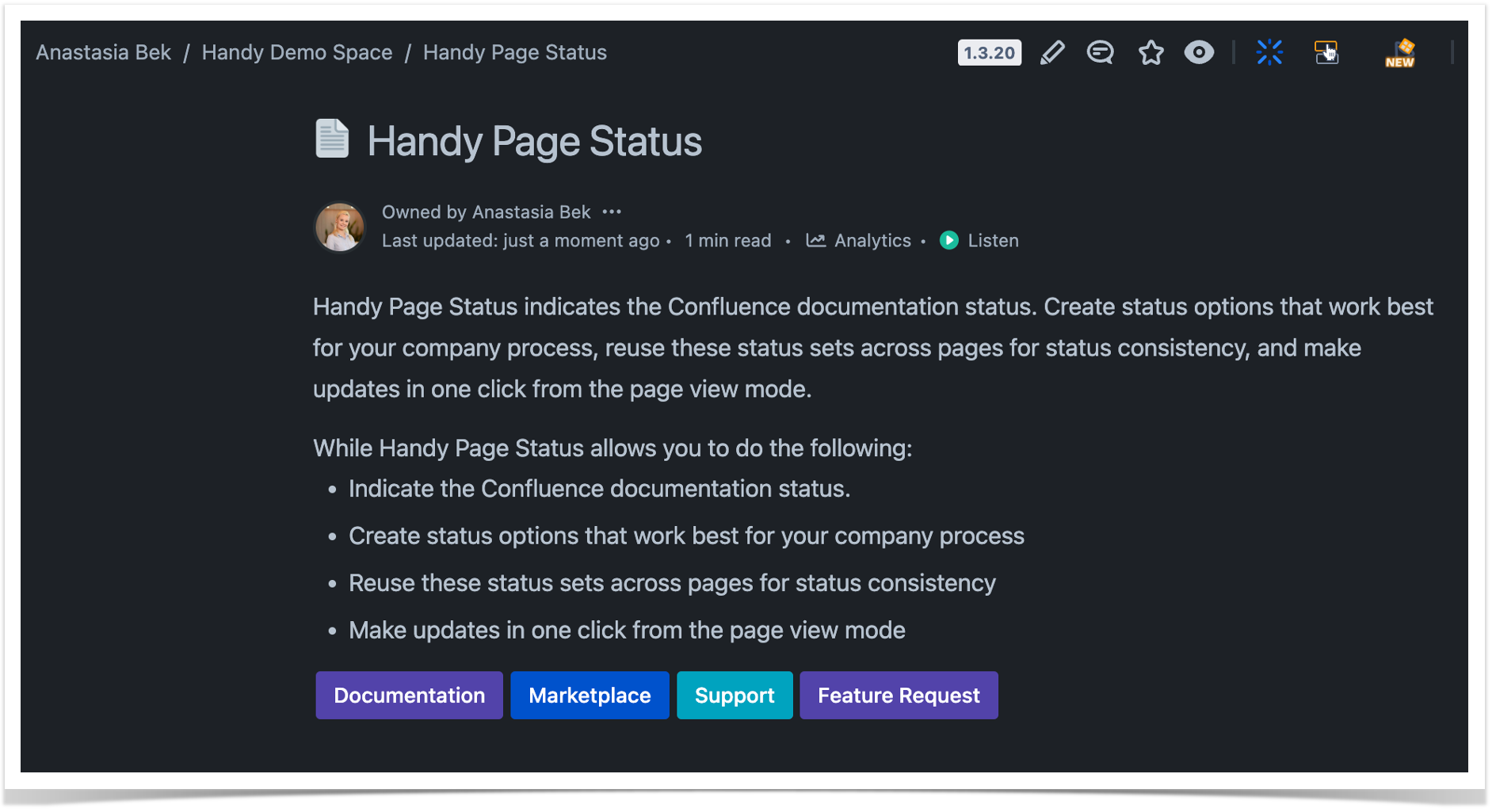
So, James keeps it simple with the release versions. Page Status is assigned to each feature/bug fix page, eventually forming a release. This way, users know when to expect the feature/bug fix to be delivered.

Workflow with Confluence Page Status

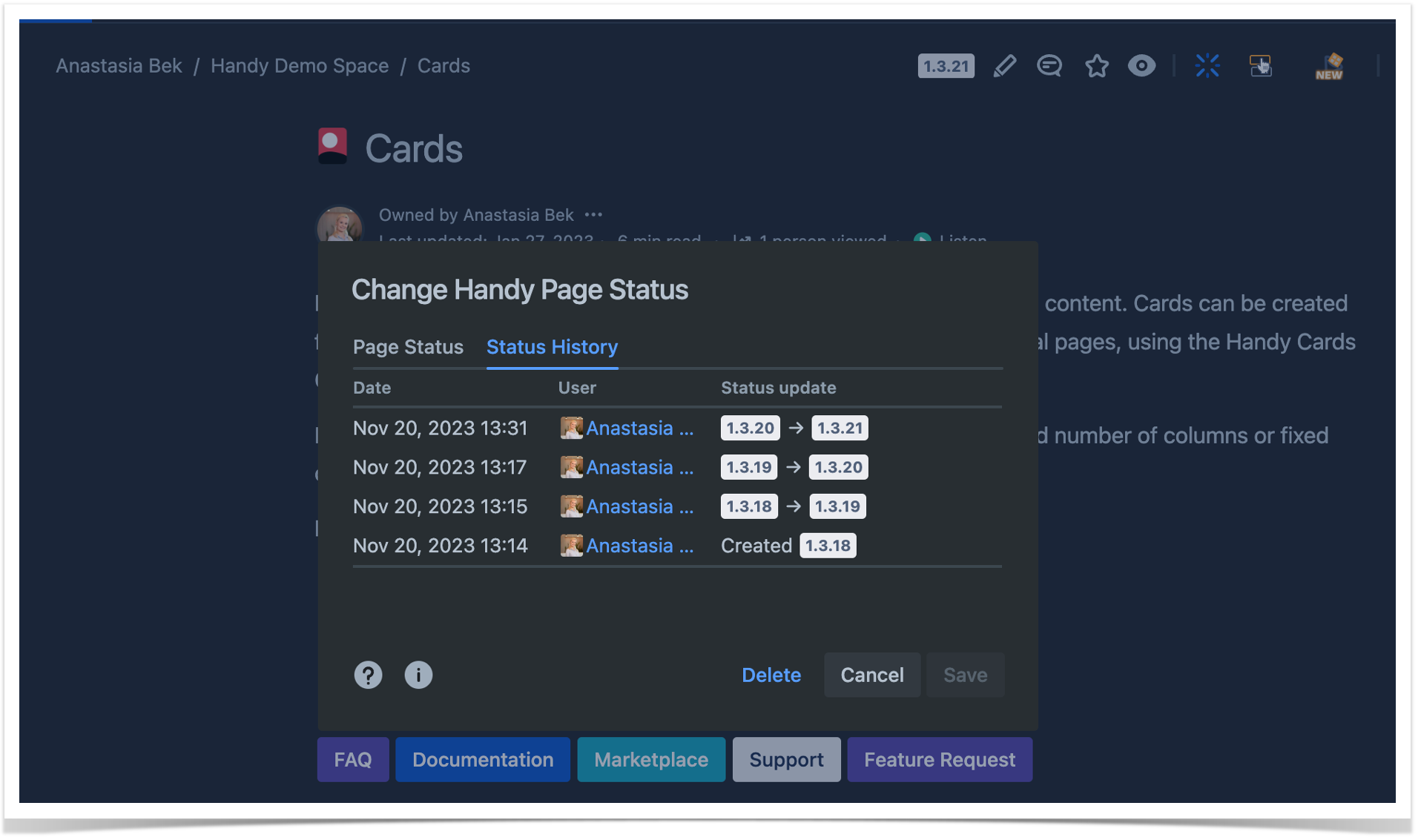
All the changes can be done directly in the mode. James and his team can always check for the dynamics if everyone has been waiting for the delivery for ages. James can view the history of the Page Status updates to validate the point or’ ages’ hypothesis in a few clicks. Sometimes, the path is straightforward; sometimes, it’s a bumpy road.All the changes can be done directly in the mode

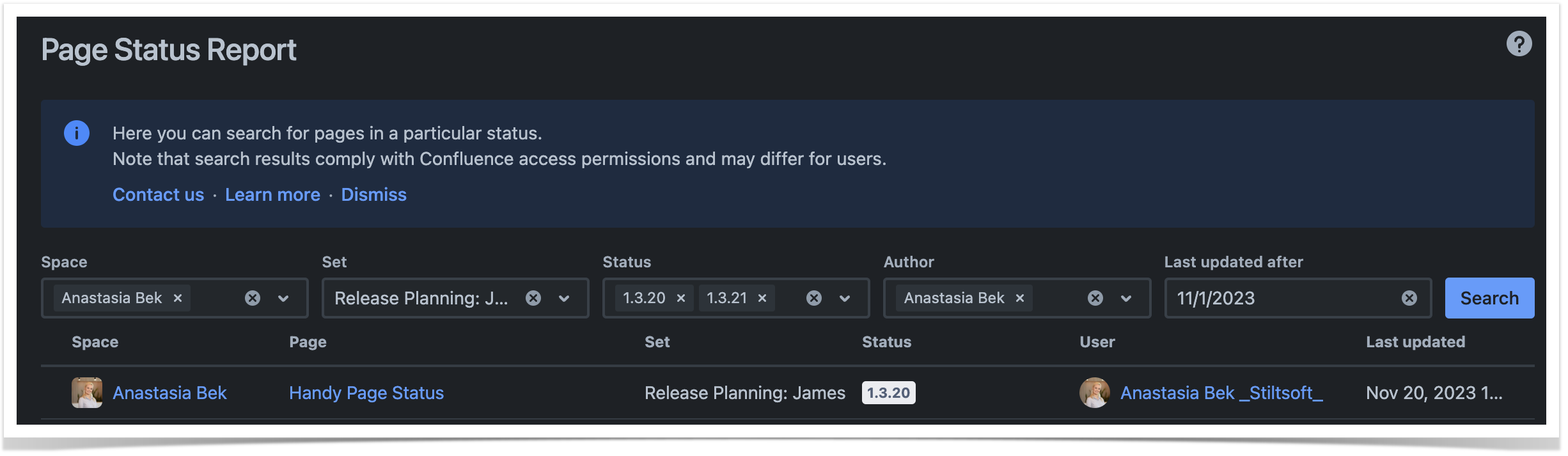
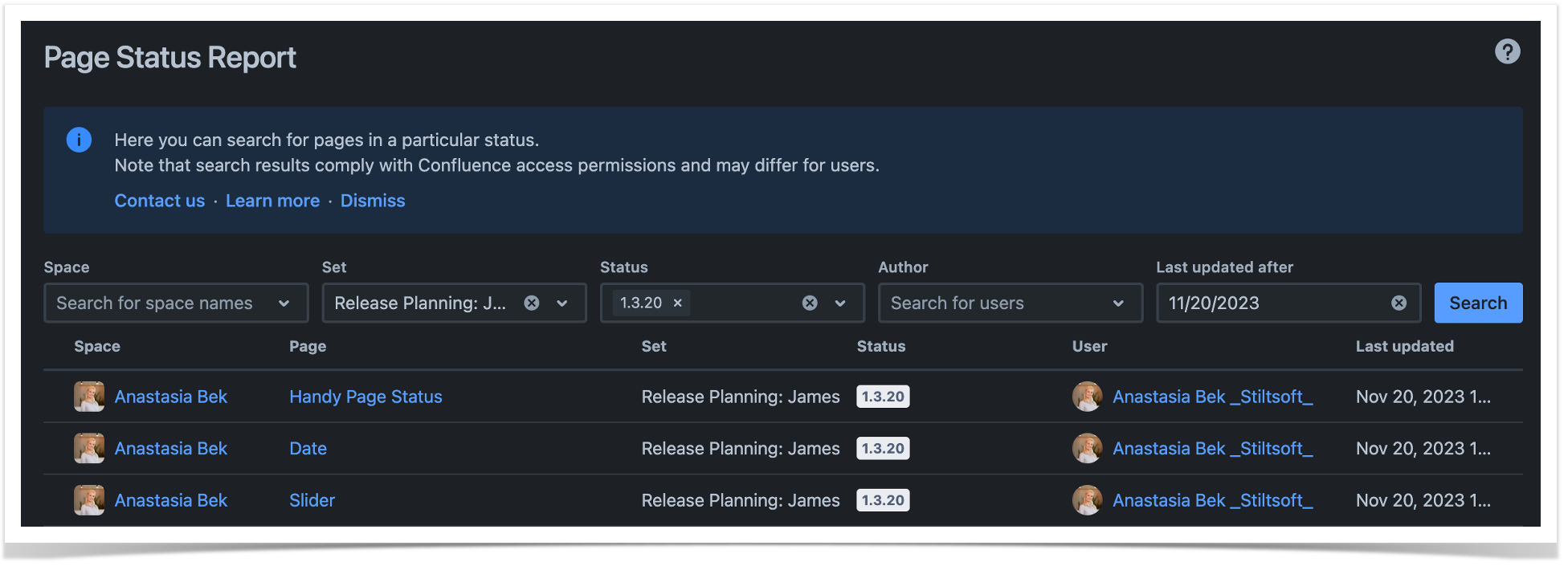
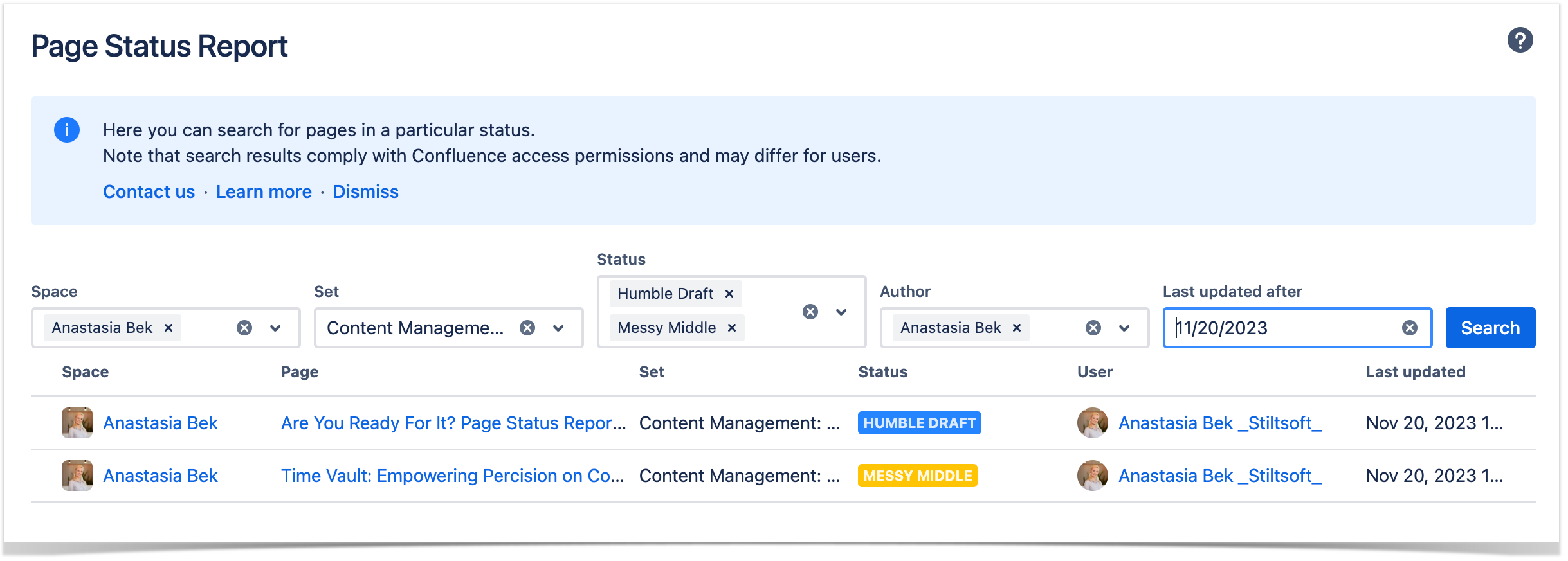
With multiple Confluence pages actively and dynamically worked on, it is essential to silence the noise and focus on the priority task. James’ priority task is to lock the upcoming release 1.3.20.  He also needs to communicate critical release information to all relevant stakeholders. For that, he chooses appropriate space and a particular Handy Page Status; James can make the report author-specific and filter for status updates done only after a specific date. Let’s say one of the developers promised to confirm the app version on or after a particular date. The result can look like this and be customized and elaborated even further.

Page Status Report comes in HandyThe view-mode page status updates and the ability to craft a custom report in a matter of a few clicks and seconds has a lot of benefits. James and his collaborators can review the critical data at a glance and focus on the issues at hand. This saves the team a lot of time and enhances overall productivity, autonomy, and collaboration in their workflows.
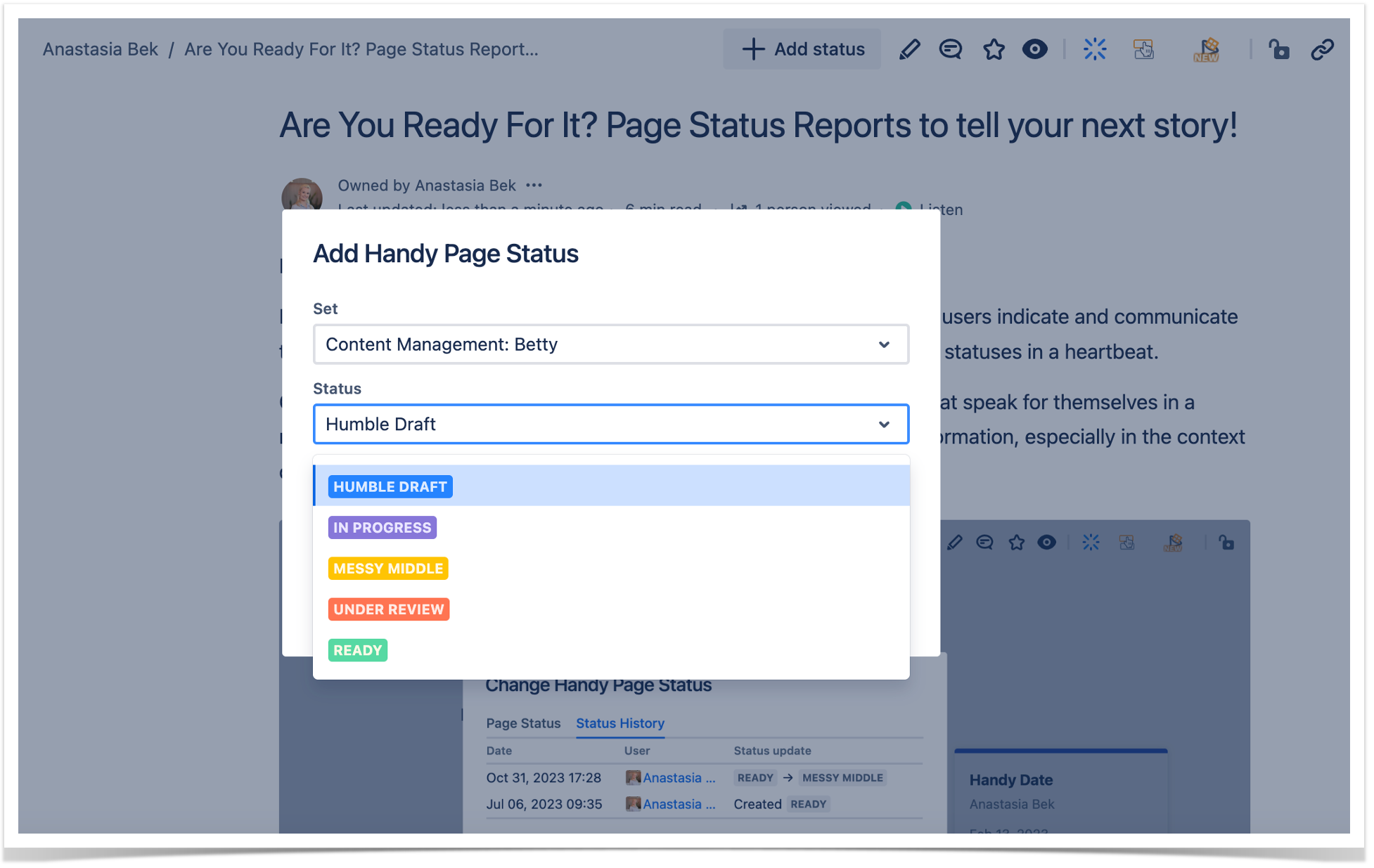

Facilitate Content Writing: Betty’s Case

Writer’s block and fear of the blank space can be scary. Betty sees Handy Page Status as a game-changer (and a lifesaver). Often, the root cause of her writer’s block is that the feedback on the working piece is given well in advance while still being a work in progress. So, Betty invented her superheroes in the form of Handy Page Status to avoid the frustration associated with the feedback given well in advance by indicating clear expectations on the pages. And if you’re asking if she has a favorite page status, a ‘MESSY MIDDLE’ is Betty’s favorite.

Betty’s collaborators and readers love the new workflow as well. They know that while it is interesting to witness the process or see how the messy middle evolves, they’re invited to the party only when the ‘UNDER REVIEW’ and ‘READY’ page status is indicated.Facilitate Content Writing

Humble Drafts and Messy Middles are good, but those are also the ones that need a check-in or clean-up. How many of those does Betty have? What can be done about the ones in those states? And what if Betty needs to review her work only in a particular space after today? For this case, use the Handy Page Status report with the required search parameters.Handy Page Status Report data

With this solution and specific spaces for which Betty writes content, Betty can locate her not-so-work-in-progress items and see what can be done about them with just a few clicks. She is also having her superhero moment because now she needs to browse only through the Handy Page Status Report data vs. looking through her notes/manually exploring Confluence pages. Besides, her colleagues benefit a lot from the report. Everyone can see what’s new and ready to be read in the Blog space regularly without getting ‘content dupes’. Here the Last updated after field can help them with that even if they like only to read fresh blog updates each Friday.

Closure

Betty and James work in different departments, and their daily workflows are different, too. Still, they are impressed with the diversity and customization opportunities of Handy Page Status and Page Status Report functionalities. Moreover, Betty and James are eager to spread the word to the other teams who can benefit from incorporating the opportunities into different fields like project management or documentation review.

You can check out the Handy Page Status Management in action by trying it out in Confluence Cloud to see how you and your team can benefit from it. Feel free to check out Handy Macros for Confluence at the Atlassian Marketplace to see if this app can be a good fit for your needs and use cases.

Unlocking the Power of an LMS in Confluence for Efficient Employee Training

March 14, 2023
#Confluence#Learning Management
6 min

Employee training is an essential part of any business. It helps employees understand their roles, increase productivity, and stay current with industry trends.

To maximize the effectiveness of employee education, many companies turn to modern solutions for learning management. Of course, choosing the right solution for top-notch training can be challenging.

We think that one of the best ways to do this is to provide training tailored to each employee’s needs. As such, you can use the software that your team is familiar with, like Confluence. By adopting this approach, companies can reduce the time and resources they spend on training while also providing their staff with the tools they need to succeed.

Let’s see how to elevate employee education by leveraging a learning management system in Confluence.

Why use LMS in Confluence for employee training

Confluence is a remote-friendly team workspace that allows users to create and share content, collaborate, and access various learning resources. You get a centralized platform for managing content, reducing the need for multiple third-party tools. Furthermore, Confluence allows users to easily structure content in a cohesive way, which helps accelerate the learning process.

We bet that you already have a lot of information in your Confluence that training administrators can use for employee education. So turning your Confluence into a fully-fledged learning management system is a great idea. And it is possible with the help of izi – LMS for Confluence. This app requires minimal setup and makes Confluence more powerful and user-friendly, allowing companies to quickly get their courses up and running. And employees, in turn, get an interactive environment to engage in.

Create courses in Confluence

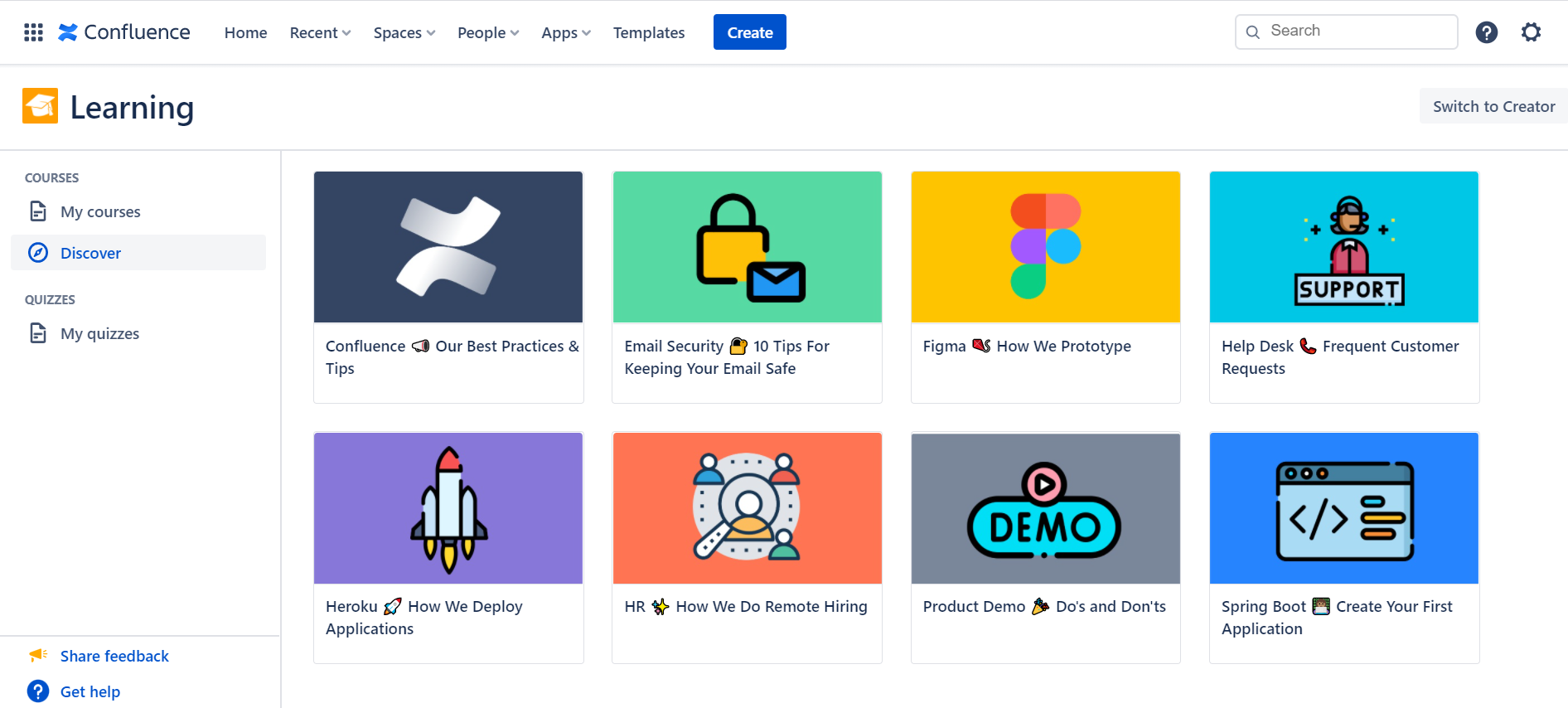
Setting up an LMS in Confluence is quick and easy. After installation of the app, creators and learners get immediate access to the Learning portal in Confluence.

lms-in-confluence

Learning administrators can create courses from the portal view or from anywhere in Confluence by clicking the Create button and using the Course template.

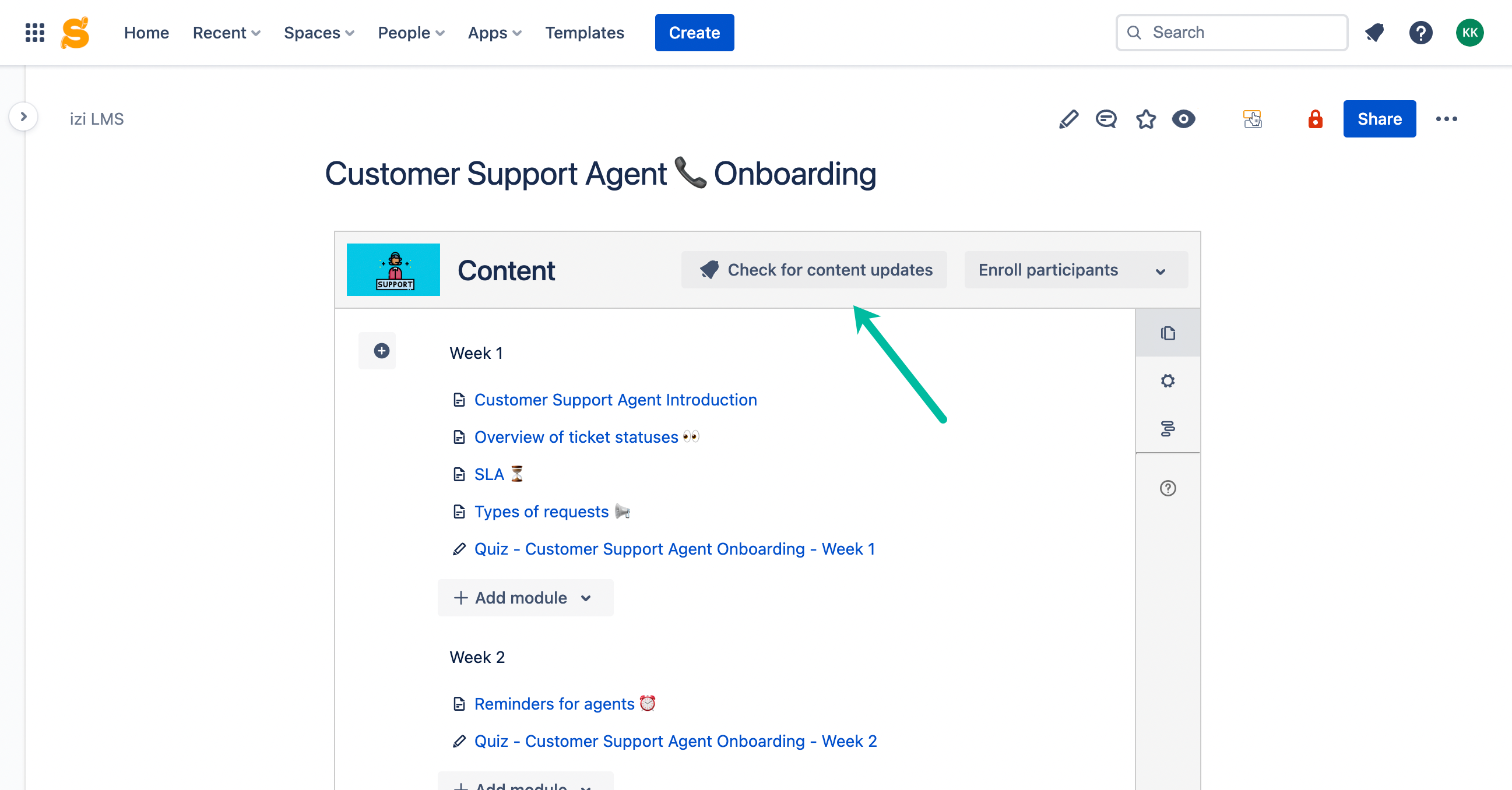
One of the main advantages is that izi LMS allows reusing the existing content and separate Confluence pages as training blocks of the course. Administrators can edit content if required to ensure each training module has a clear objective and the course is well-structured and easy to follow.

Populating training modules with images, videos, PDF files, and quizzes helps create engaging and interactive training materials. Moreover, administrators can update content for already enrolled course participants. In this case, employees receive the most up-to-date information when something has changed in the process covered in the course, or there is a new training module.

Check for content updates

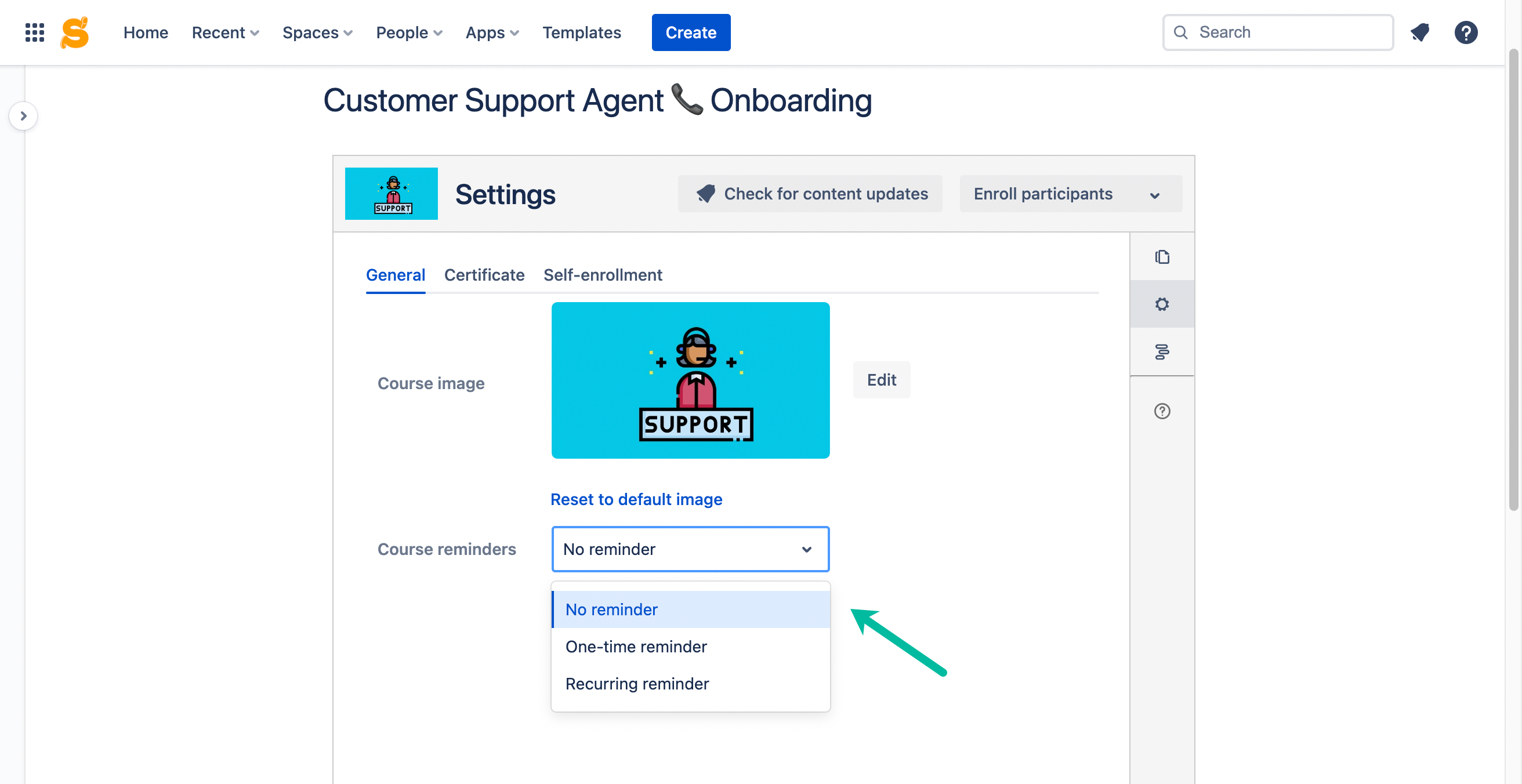
To notify course participants about the necessity to finish the course, creators can set up automatic reminders for course participants.

Course reminders

Enjoy a smooth learning process

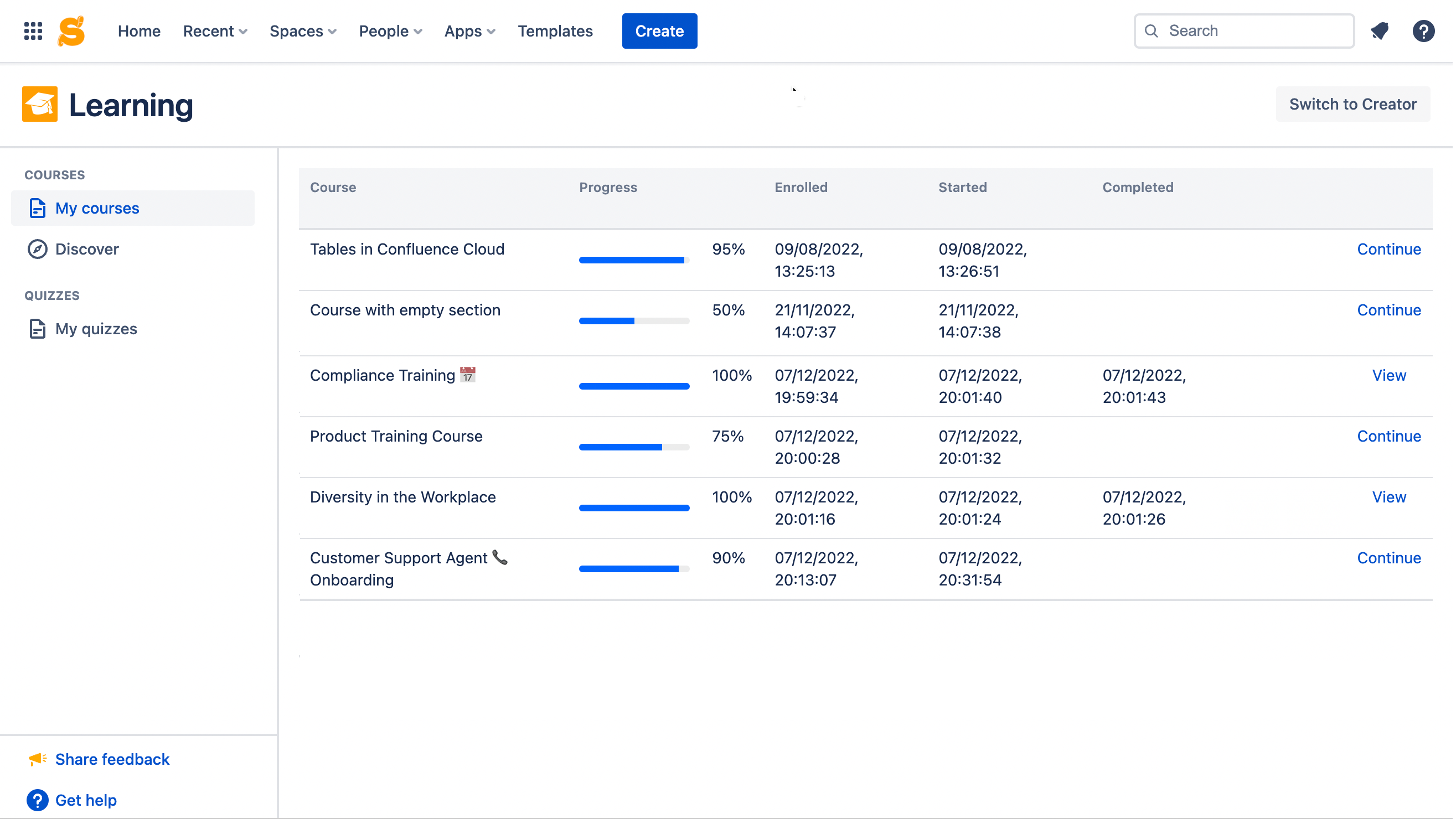
Confluence users can browse the Learning catalog of available courses and self-enroll in the ones they find interesting. Also, they see their progress in the courses they are taking.

My courses in Learning

Learners see every course as a set of training modules they need to study carefully and complete one by one. Courses can contain quizzes that help assess user knowledge and understanding. This allows course administrators to rapidly identify gaps in knowledge to pay attention to and adjust courses accordingly. Questions can be of four different types:

  • single choice
  • multiple choice
  • true/false
  • free text

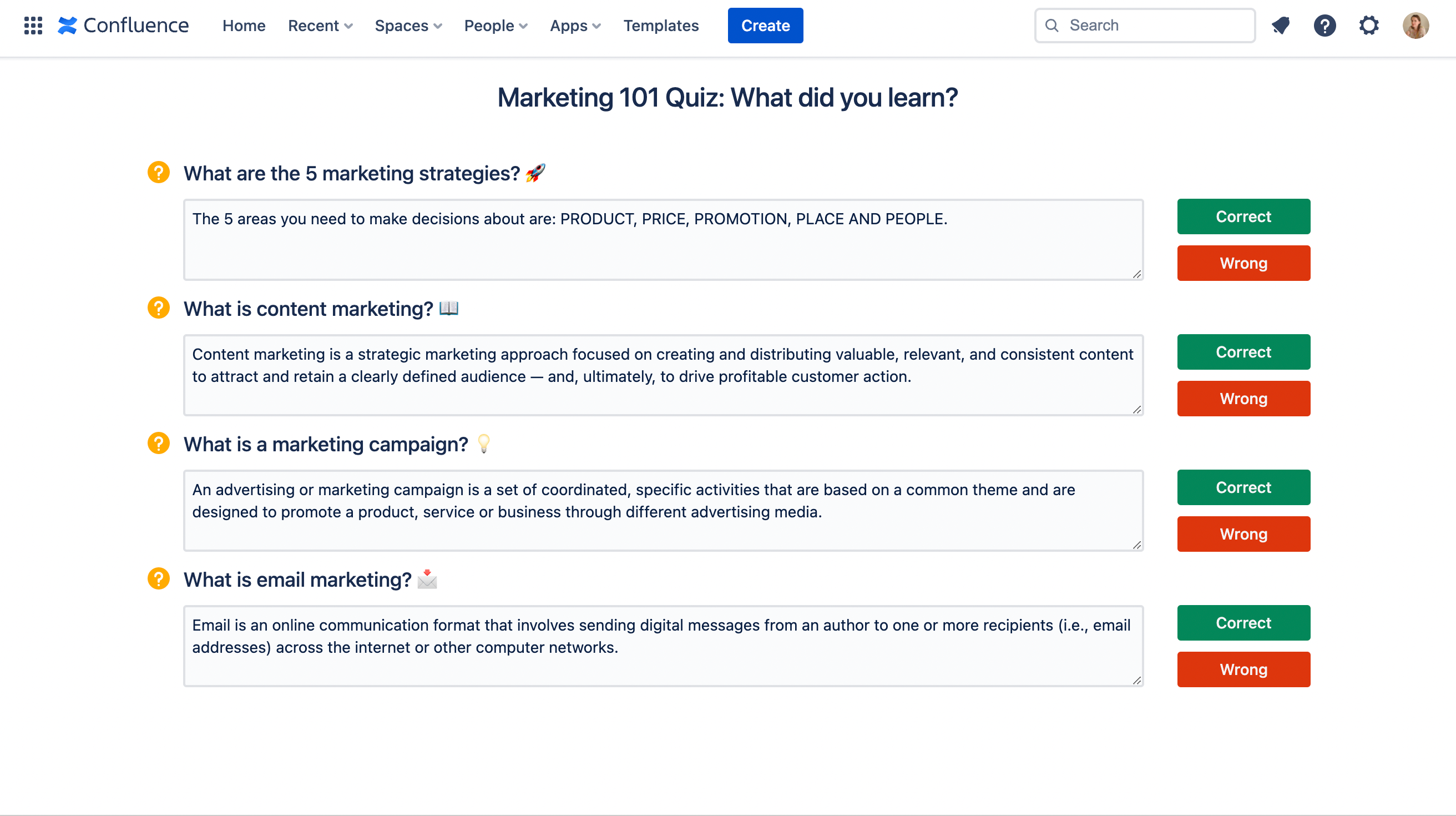
Free text questions let participants share their thoughts on the question with the course creator, who then needs to review answers and mark them as correct or wrong.

Free text review page

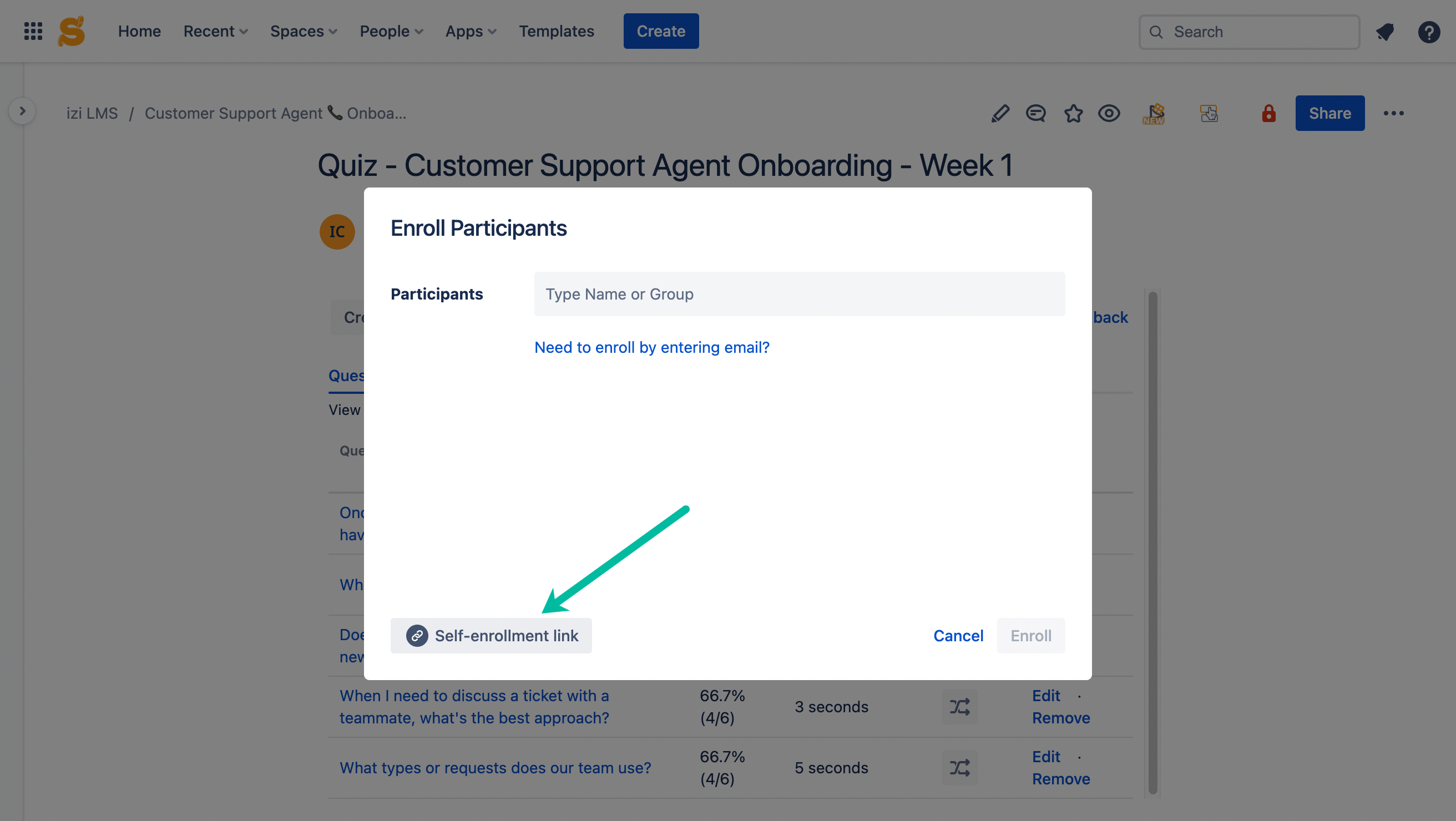
Participants can self-enroll in quizzes with a link. This facilitates the task of inviting multiple users to a quiz without typing their names individually.

Quiz self-enrollment link

After course completion, participants get certificates they can download and share with their colleagues or on social media. It helps increase employees’ engagement and productivity.

Course certificates for participants

Read more about how to ace employee certification in Confluence with the help of courses.

Track participants’ progress with reporting

One of the most common challenges is ensuring employees are motivated to complete courses. To overcome this challenge, it’s crucial to track their progress and guarantee they are meeting the necessary objectives, as well as gain insights into where additional training may be needed.

izi – LMS for Confluence lets course administrators track participants’ activity, assess their performance and generate reports both for courses and quizzes they take.

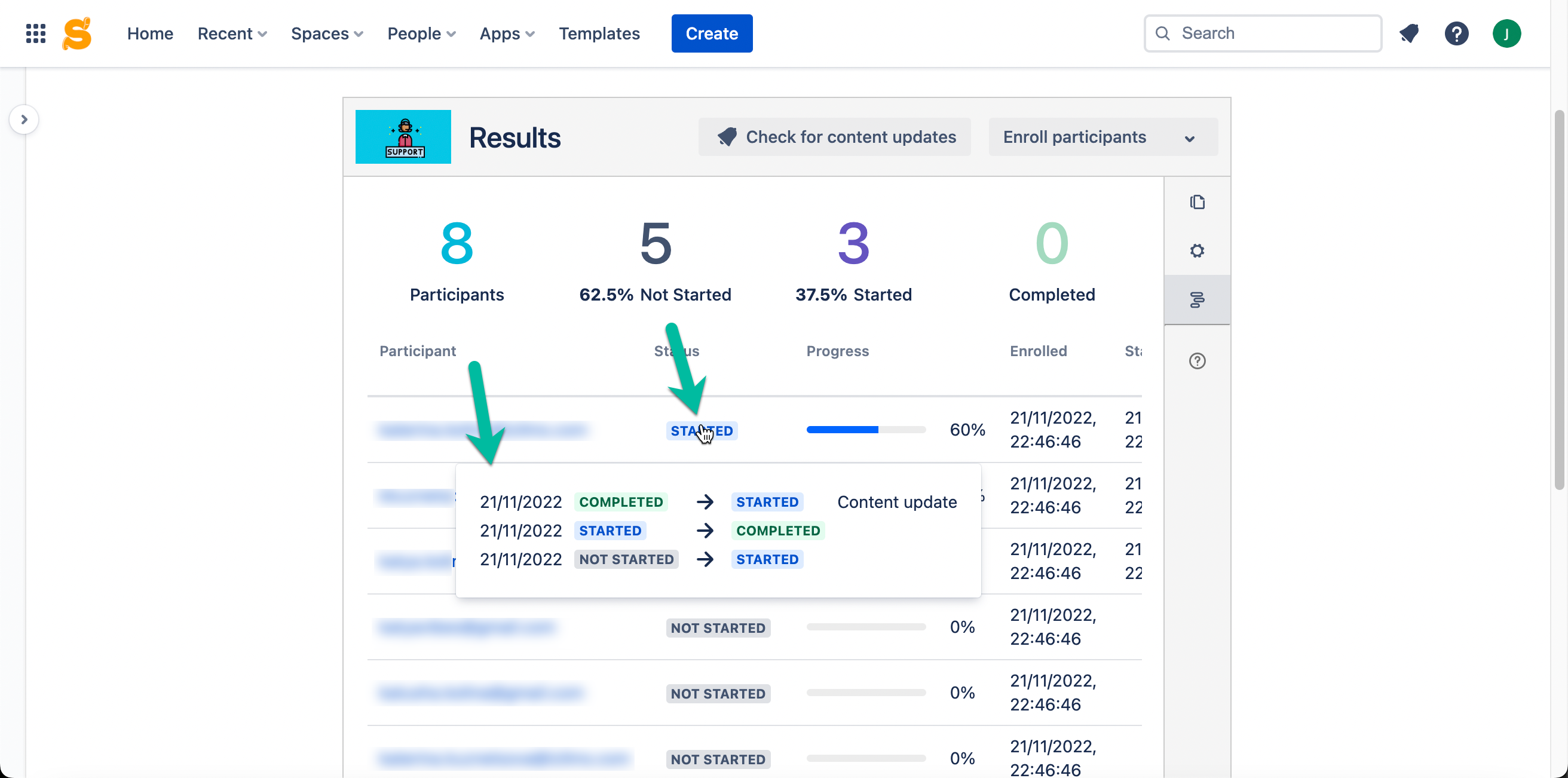
For example, every course report shows statuses such as Not started, Started, and Completed. Moreover, hovering over the status, you can see the status change history. This feature provides course administrators with a birds-eye view of course progress among all the participants.

Course history of status changes

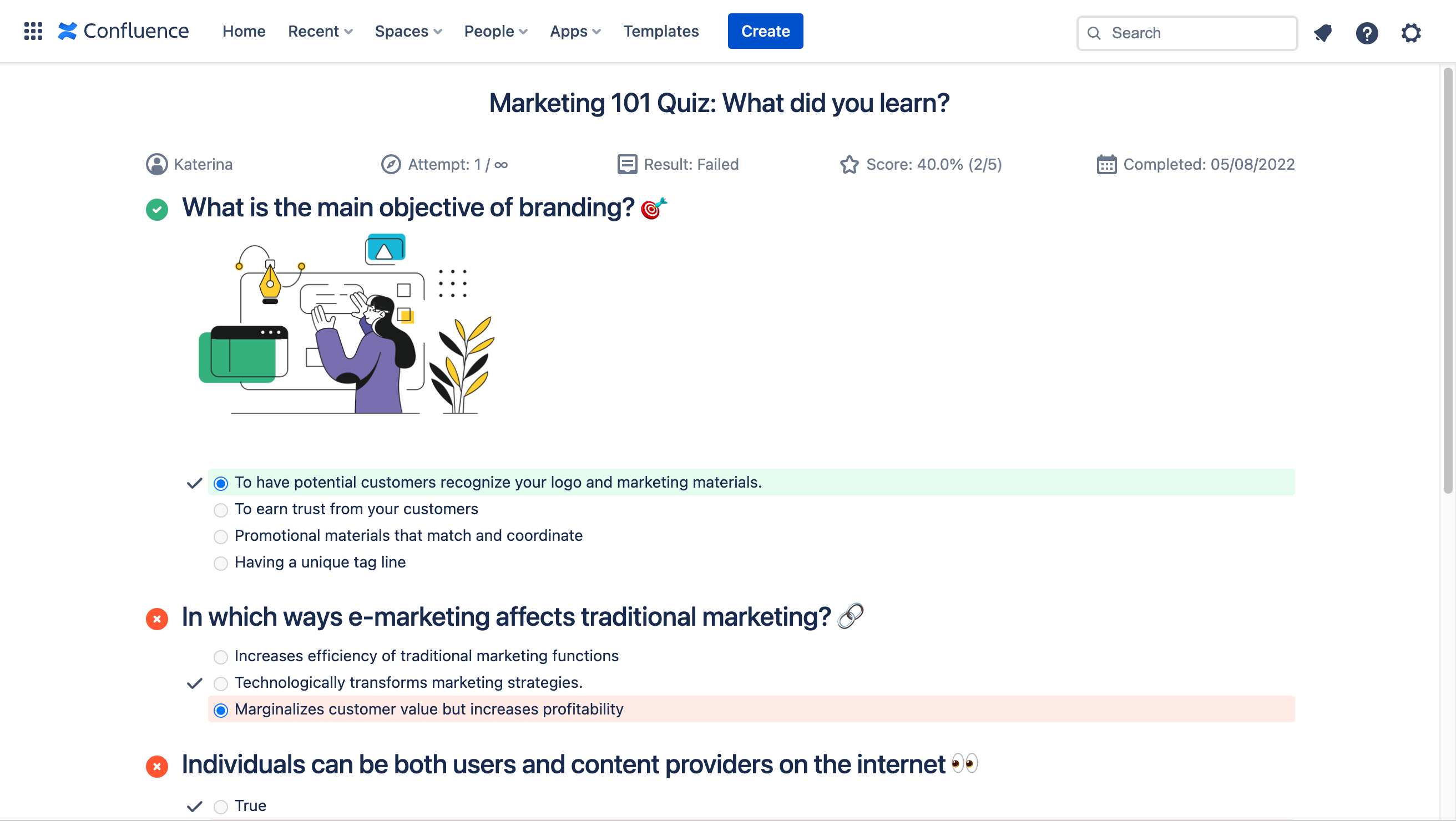
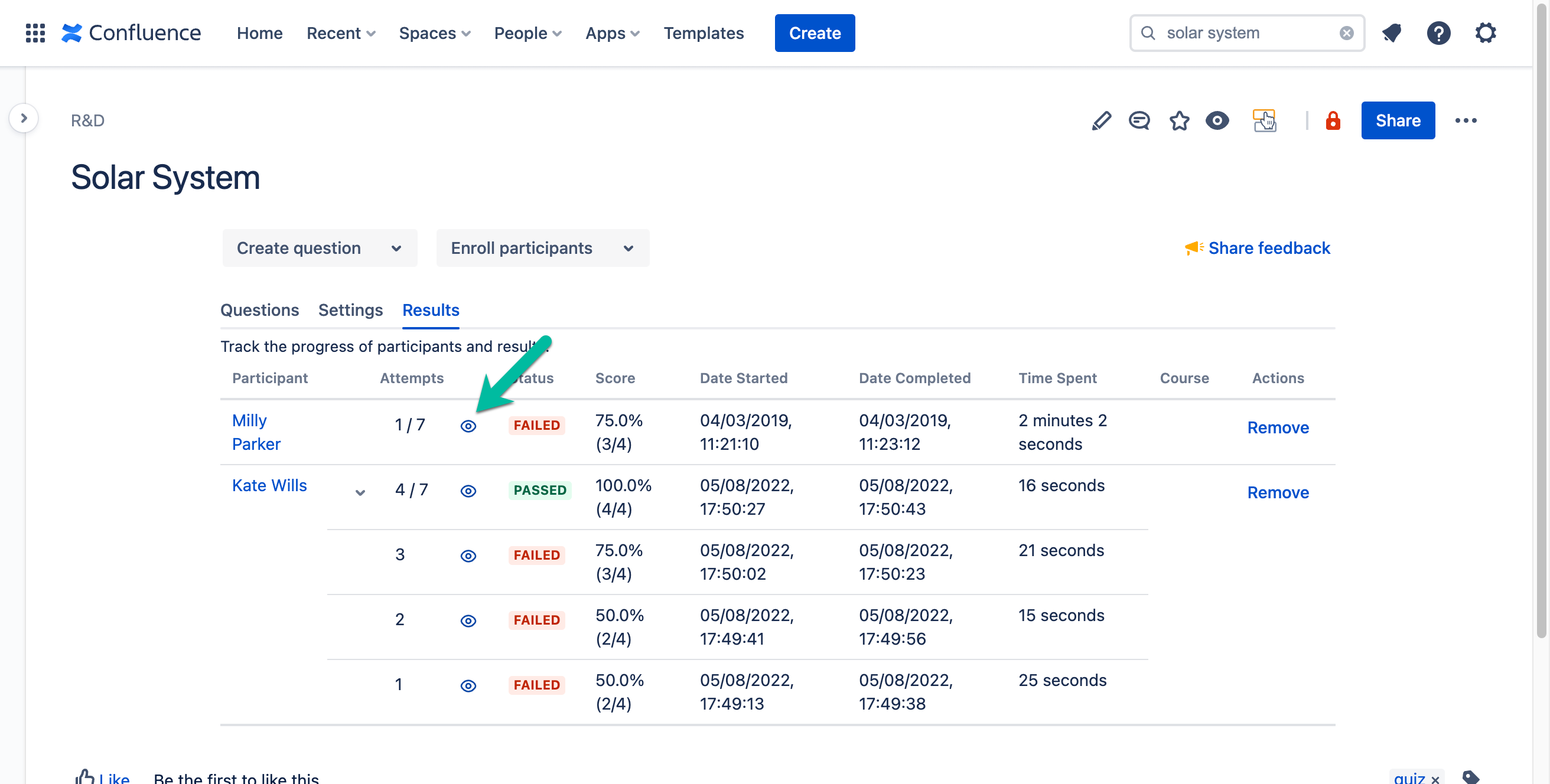
When it comes to quizzes, course creators can view answers participants gave while taking a quiz vs. correct answers.

Take advantage of an LMS in Confluence

With a suitable learning management system, businesses can ensure their employees receive the education and training they need to succeed. This approach benefits for both the company and its employees, as it allows them to manage their learning and development effectively.

Whether you’re looking for a way to master employee onboarding, level up compliance training, or improve self-directed employee education, izi – LMS for Confluence has got you covered. It allows you to set up courses, track employee progress, and measure their performance on the fly right in Confluence, the software you already know and enjoy using.

Try izi LMS for free and check how it can power up your training processes. The app is available for Confluence Cloud and Data Center.

Connecting Sharepoint and Atlassian Confluence together

February 18, 2021
#How To#Confluence
4 min

Did you know that switching between different systems and apps is not only annoying but costs businesses hundreds of billions of dollars annually due to wasted time? Enabling users to immediately find the information they are looking for is crucial to empower efficient teamwork.

Let us imagine you want to create an overview of an upcoming marketing campaign in your Confluence. Having all information and documents available on this specific page helps all employees, from marketing to sales, to get what they’re searching for with ease. But how do you accomplish such a comprehensive overview?

SharePoint Connector for Confluence

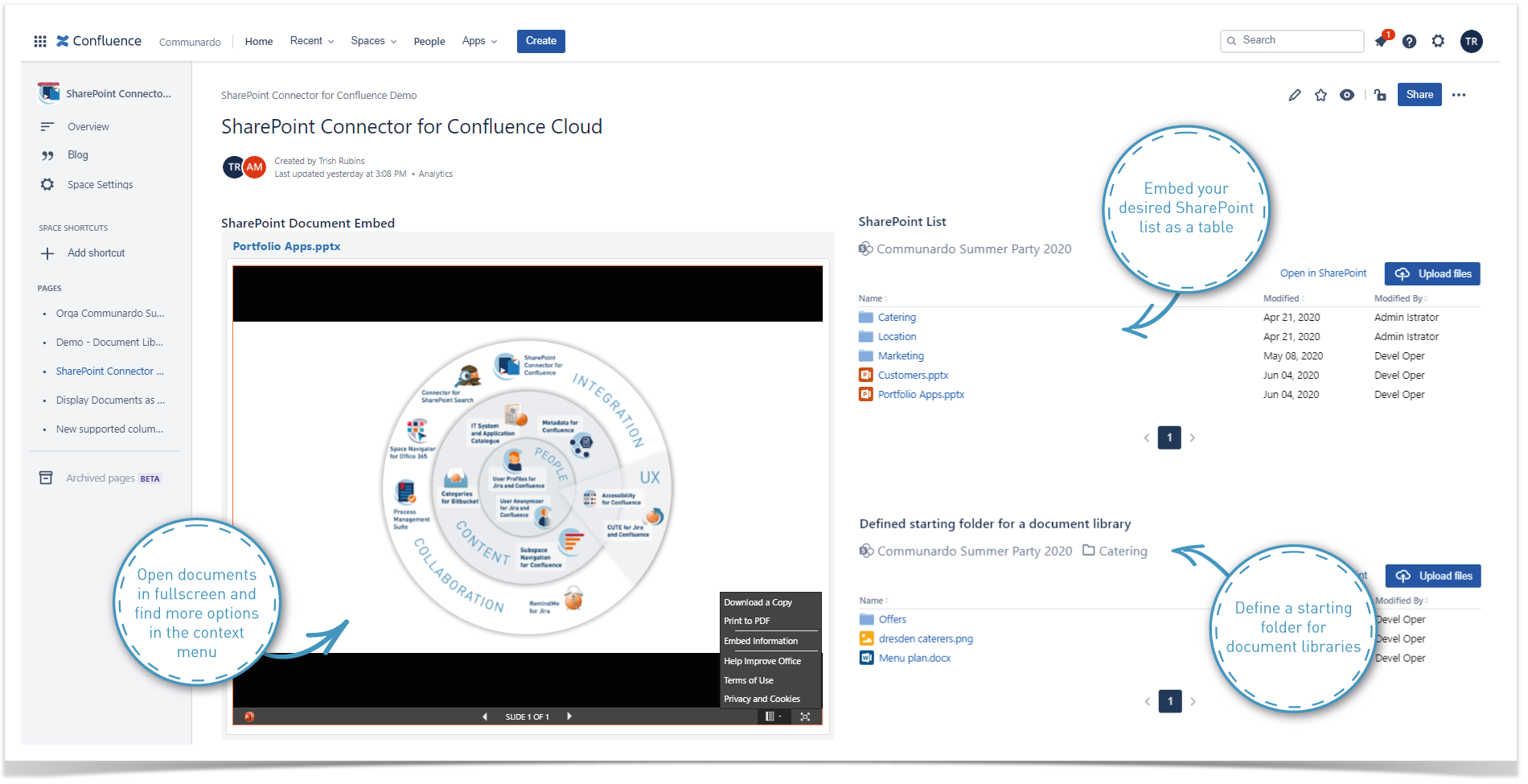
Communardo’s SharePoint Connector for Confluence is here to help! By integrating Confluence and SharePoint, you enable a seamless work experience and get the best out of both worlds. The app makes it possible to easily embed SharePoint content into Confluence.

Using the SharePoint document macro, you can either embed full-views or links of SharePoint documents as simple as posting the document URL. In case you got many files to share, you can even choose to embed a whole SharePoint document library. Now your colleagues can easily edit documents without the need to navigate to SharePoint first.

sharepointconnector embedinconfluence

The SharePoint Connector for Confluence is available for all Atlassian hosting options (Cloud, Data Center, Server), as well as SharePoint Online (as part of Microsoft 365/Office 365) and on Premise (2016, 2019).

» Start my free trial of SharePoint Connector for Confluence

Smart Attachments for Confluence

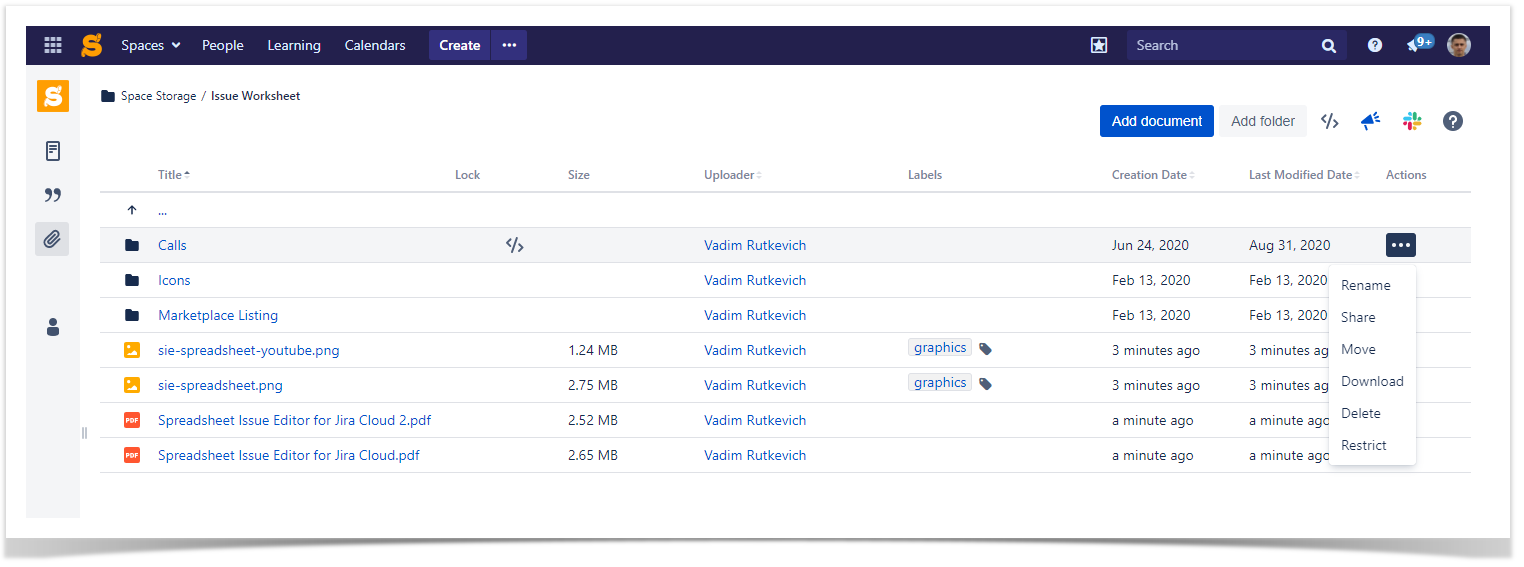
If once you decide to finally migrate your document library from Sharepoint to Confluence, the Smart Attachments for Confluence app is the first option to consider. It integrates with Confluence and allows you to create local file storages within your Confluence spaces.

For those of you who migrate from Sharepoint, you can just drop all your existing folders with files and internal folder structure, and the app will recreate this structure from scratch. So that you can preserve all your folder structures and files as you have them in your Sharepoint.

space storage

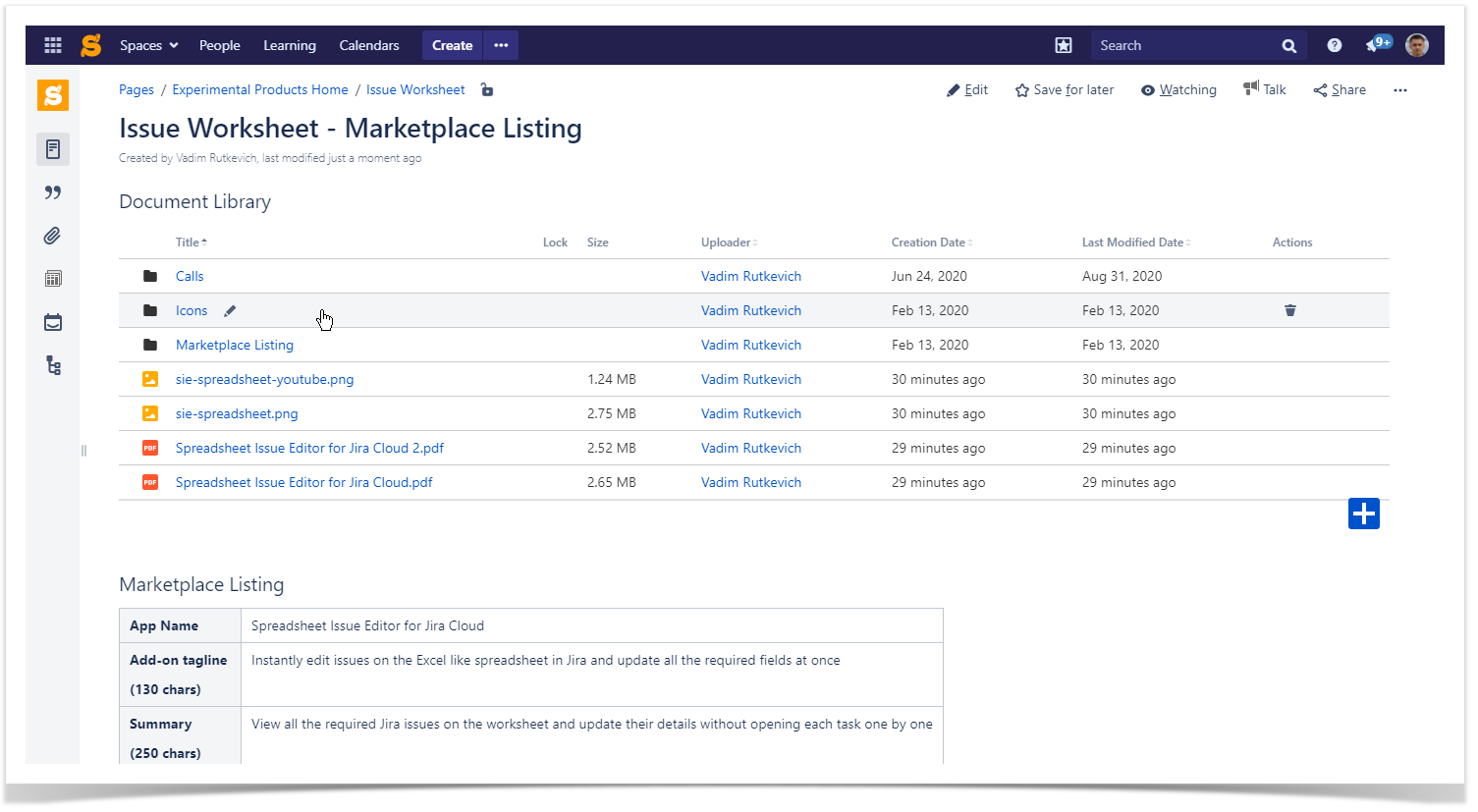
You can perform all the basic operations on folders and documents, keep document revisions, manage labels, or move them between folders of yours. What stands this app from others is that it closely integrates with Confluence itself, so as a result, you can preview all the files and documents, edit them with Atlassian Companion, embed them into Confluence pages, and, of course, comment on them. This greatly simplifies the end-user experience and reduces the number of context switches, which leads to better productivity of your team.

By default, the file storage is available to all Confluence users, and the availability of specific features is regulated by space permissions, so you needn’t adjust anything in your access control policies and go as is. The app also lets you perform non-trivial tasks, such as:

  • lock a specific document against edits while you are editing or reviewing it
  • restrict access to folders with sensitive information
  • share a folder with documents with some external users who do not have regular access to your Confluence, for example, when sharing assets with your customers.

files on the page

To minimize the necessity to constantly switch to the file storage, you can embed specific folder structures into Confluence pages. This way, you can instantly view, edit, and upload documents from your Confluence pages without losing your current page context or interrupting your activities.

» Start my free trial of Smart Attachments for Confluence

Bring Sharepoint capabilities into Confluence

It is no longer a problem to show Sharepoint content in Confluence. As of now, you can consider two options:

Which option to choose? Try both options and then decide which better fits your needs. Have any questions? Leave your comment and we will reply to you shortly.

How to Power up Page Properties Report in Atlassian Confluence

July 17, 2020
#How To#Confluence Tutorial#Confluence#Document management#Reporting
1 min

We’ve recorded this presentation for the online Team Up Forum hosted by k15t and Scandio.

Discover how to power up the Page Properties Report macro with the help of two apps:

You can easily filter and aggregate information on Confluence pages. Moreover, you can create your set of statuses and change them in the page view mode on the fly.

Discover our comprehensive list of apps to boost your project planning capabilities here!

If you have any questions, feel free to comment on this blog post below. Don’t forget to subscribe to email notifications about new articles in our blog.