Revamp of the Blog Post: Atlassian Certification: Steps to Get Certified Hey there! Ready to take the plunge into the world of Atlassian certification? Follow our step-by-step guide to ace your Atlassian certification journey and unlock new opportunities in your career. Get certified today and step up your professional game with Atlassian Certification. Revamp of the Blog Post: Atlassian Certification: Steps to Get Certified Delve into the realm of Atlassian certification with our comprehensive guide. Elevate your career prospects by obtaining your Atlassian certification today. StiltSoft recently attained Atlassian certification, solidifying our position as an Atlassian Solution Partner. Join us on this rewarding journey! StiltSoft has successfully passed Atlassian certification this year. We have confirmed our Atlassian Solution Partner status (former Atlassian Experts status). It was an interesting and, of course, challenging experience we want to share.
If you are an experienced Atlassian administrator, it is high time to move to a new level and become an Atlassian Certified Administrator (ACP). This formal assessment from Atlassian confirms your skills and helps you join the elite group of Atlassian professionals.
We have already studied this topic down to the very last detail. We will tell you why every Atlassian administrator should get certified in 2017.
This blog post will highlight the key aspects of the Atlassian certification process.
Let’s proceed to another Atlassian product – Confluence. It is a team collaboration platform where you can create and share rich content in a transparent and organized manner. This web-based enterprise information management platform helps you keep track of your team projects, discussions, decisions.
Confluence is a tool that enhances your productivity and simplifies the decision making within your teams and departments. Check out its intuitive interface with the carefully-elaborated workflows. Once you explore the basics of Confluence, you will understand that it is pretty simple to use.
We will highlight some of the resources to consider when looking for the best way to learn Confluence essentials:
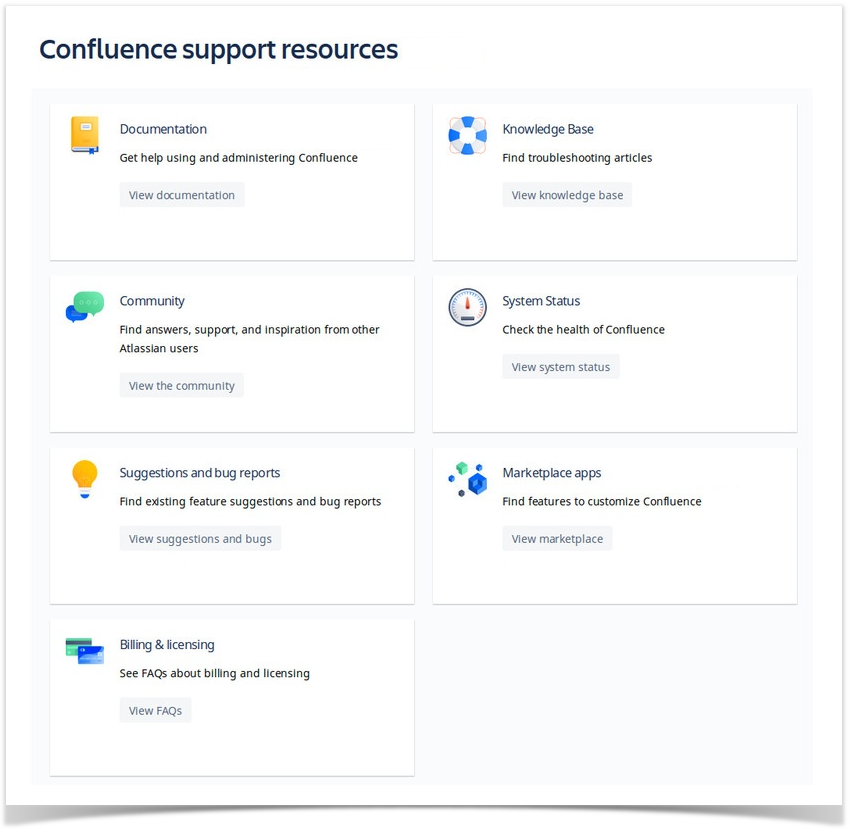
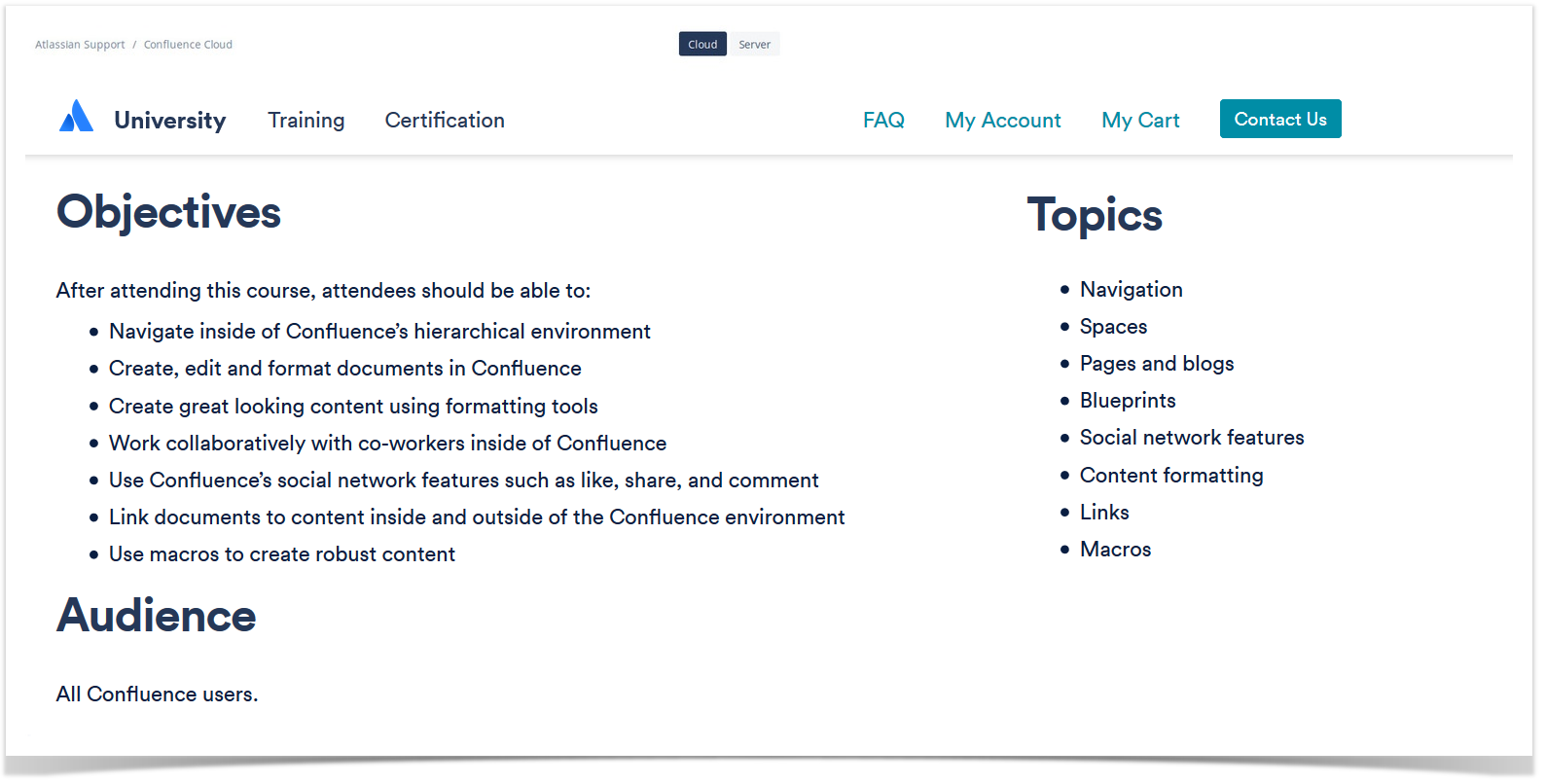
Atlassian sources: documentation, blog, University, and YouTube channel.
Starting your Confluence experience from Atlassian documentation makes sense. Here you will find all the required information for using Confluence to its full extent.
Both Confluence Cloud and Server Documentations have the same contents structure.
You can check two useful tutorials ‘Navigate Confluence‘ and ‘Space ace‘. In Confluence Server Documentation you will also find a quick start guide with the detailed Confluence information. At first, it may seem that there is too much information for a beginner. No worries, just follow the well-structured step-by-step guide.
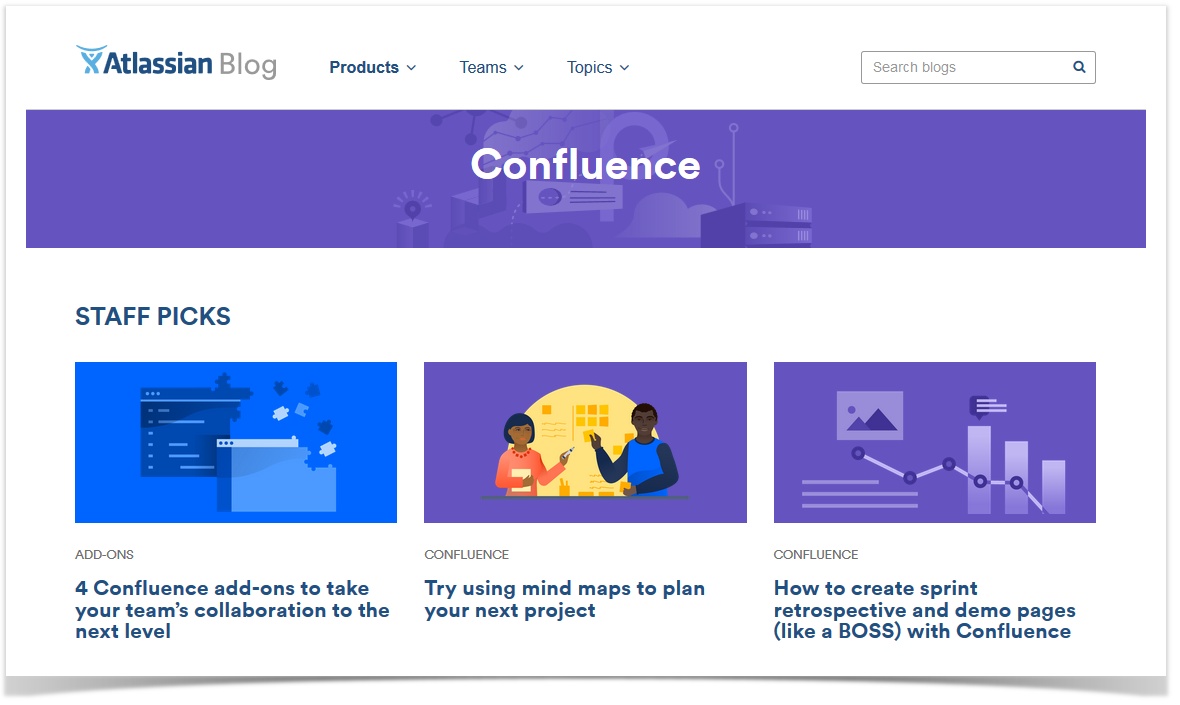
This blog is full of useful tips for all Confluence users and is essential if you want to be aware of the latest Confluence news.
You may sort out the articles by topics you are interested in. You will find blog posts about the latest Confluence features, new add-ons, or real-life use cases. We recommend you to subscribe to this blog if you want to receive some fresh ideas, announcements, and inspiration for your team from Atlassian.
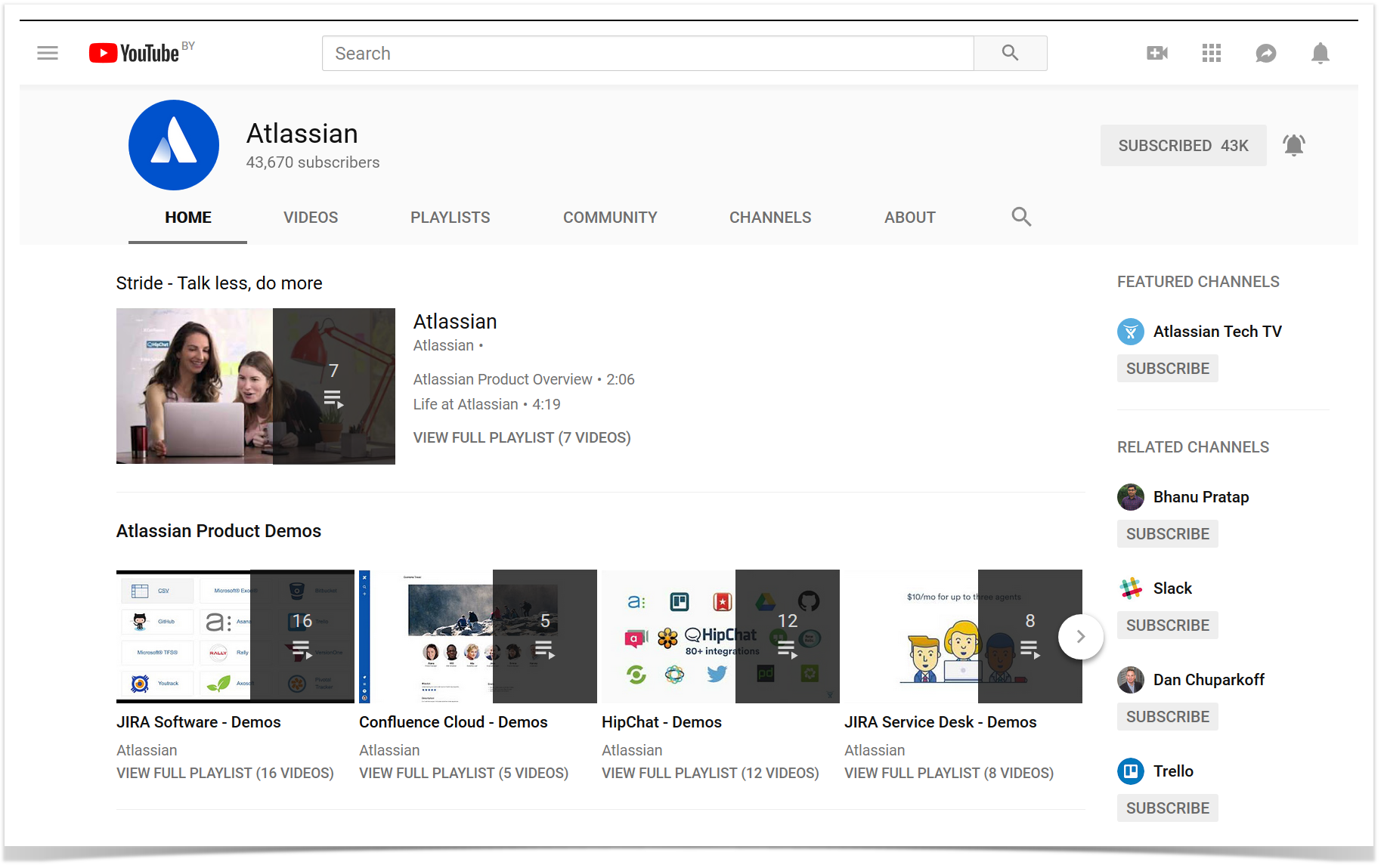
We think that practice with the help of video tutorials helps a lot, because you can follow the process step by step while listening to the tutor’s explanations. For that reason we offer you to check Atlassian YouTube channel.
All the videos are divided into topics, so it is easy to find what you need. You may like the following:
Atlassian sources is a great start if you want to understand Atlassian values and philosophy. And, of course, one more good thing about using Atlassian sources is that you get the proven first-hand solutions.
Courses from Atlassian Partners
You may ask, ‘Who can teach me Confluence basics except the Atlassian team?’ We think that the courses from Atlassian Solution Partners are worth your attention.
cPrime delivers Agile Project Management and Software solutions to large enterprises. They have training courses both for beginners and power users. We think that it is better to start with Confluence User Fundamentals – Online. This online training course consists of 4 modules, each module includes demonstration, lecture, and exercises. You will discover how to work with your page content, learn about templates and blueprint fundamentals, and will have an overview of macros.
As an Atlassian Silver Solution Partner and Atlassian Top Platinum Vendor, Stiltsoft today has 4000+ customers from more than 80 countries worldwide. Our primary focus is app development. We’ve also released our free training courses for Confluence administrators that start their experience with this powerful platform and novice Confluence users.
These courses have included all our best experience collected over the eight years of company operation.
This learning platform offers a wide range of different courses with mostly positive feedback from readers. Installing and Administering Atlassian Confluence is a good choice for beginners. You will learn how to set up and create content of all formats in Confluence, use its community and social features. This video tutorial also provides information about creating users and groups, managing tasks and notifications.
To take this course you need to sign up. After that you can choose the learning plan that suits you best.
What to start with?
Atlassian offers a trial period for all their products. We think that practice can be the best way to study Confluence. So install Confluence and try to use it for a couple of days. If you have questions, consult the Atlassian sources we mentioned in this blog post.
We offer you to proceed to the paid courses once you study free solutions and check your skills in practice. Of course, it’s up to you to decide which of the options to choose.
We hope that this blog post will help you to start your successful Confluence experience. Feel free to comment below if you have any questions about Confluence usage.
Subscribe for monthly updates on how to get the most out of Atlassian products.
Thank you for signing up
for our newsletter!
You will be the first to know about fresh content, releases,
and special projects.
Stay tuned.
How Web2Market Uses Talk – Advanced Inline Comments for Confluence
February 21, 2017
#Case Study#Collaboration#Confluence
2 min
The reason we use Talk over the standard Confluence inline comments is to be able to restrict conversations so that clients cannot see private discussions.
George Jaros (Web 2 Market)
Web 2 Market designs, develops and hosts e-commerce and e-business web sites. They are a distributed team with clients from all over the world. Web 2 Market uses Confluence for many things. One of them is working on requirements and feature specifications. The team often discusses the documents. Some discussions are internal, others involve their customers.
Extend izi – LMS for Confluence with Table Filter and Charts Add-on
January 13, 2017
#Confluence
13 min
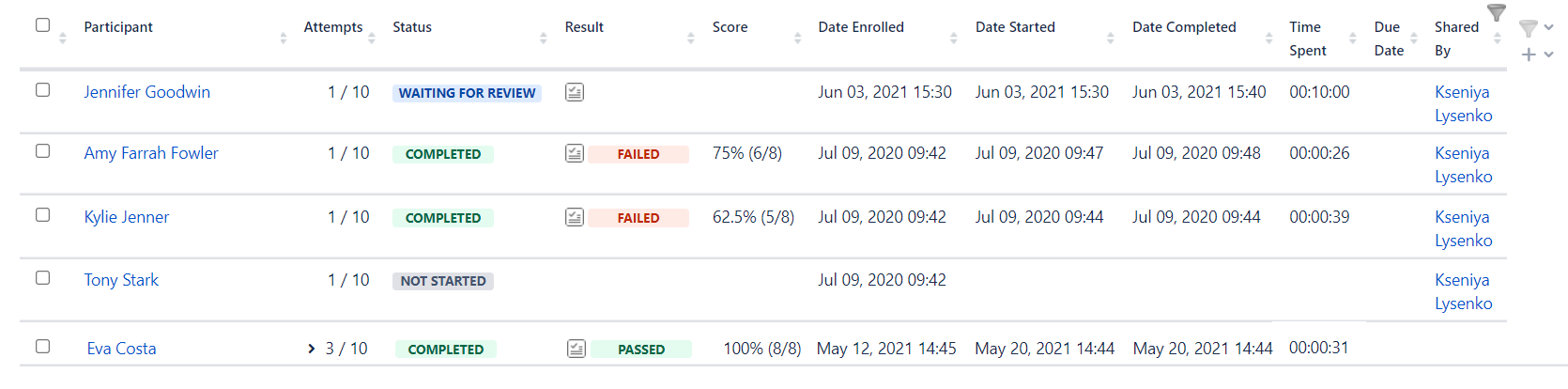
With izi – LMS for Confluence you can create tests and quizzes to assess job candidates, evaluate the skills and knowledge of employees, set up training courses in Confluence. You can assign a quiz to participants (including people without a Confluence account) by sharing a quiz link via email or set up a page for self-enrollment to let users select and take quizzes at their pace.
Table Filter and Charts for Confluence provides filters, pivot tables, charts and graphs that you can use for basically any table in Confluence, including tables generated by izi LMS.
hese capabilities can be a big help when working with tables of:
Quiz Reports and Quiz Results Reports
Course Results Reports
A quiz administrator can benefit by using the following features of Table Filter and Charts:
filters to easily find needed records in the report and hide report columns
exporting results to CSV and create custom reports in Excel
pivot tables to get ‘average’ and ‘total’ statistics of scores, statuses and results
graphs and charts tovisualize the results data
Let’s learn more about izi LMS reports and see how they can be extended with Table Filter and Charts.
Quiz Reports
By default each quiz has two reports:
Quiz Results – where you can track participants’ progress over this quiz and check their answers.
Quiz Questions – which can help you find out the questions participants fail more often than others
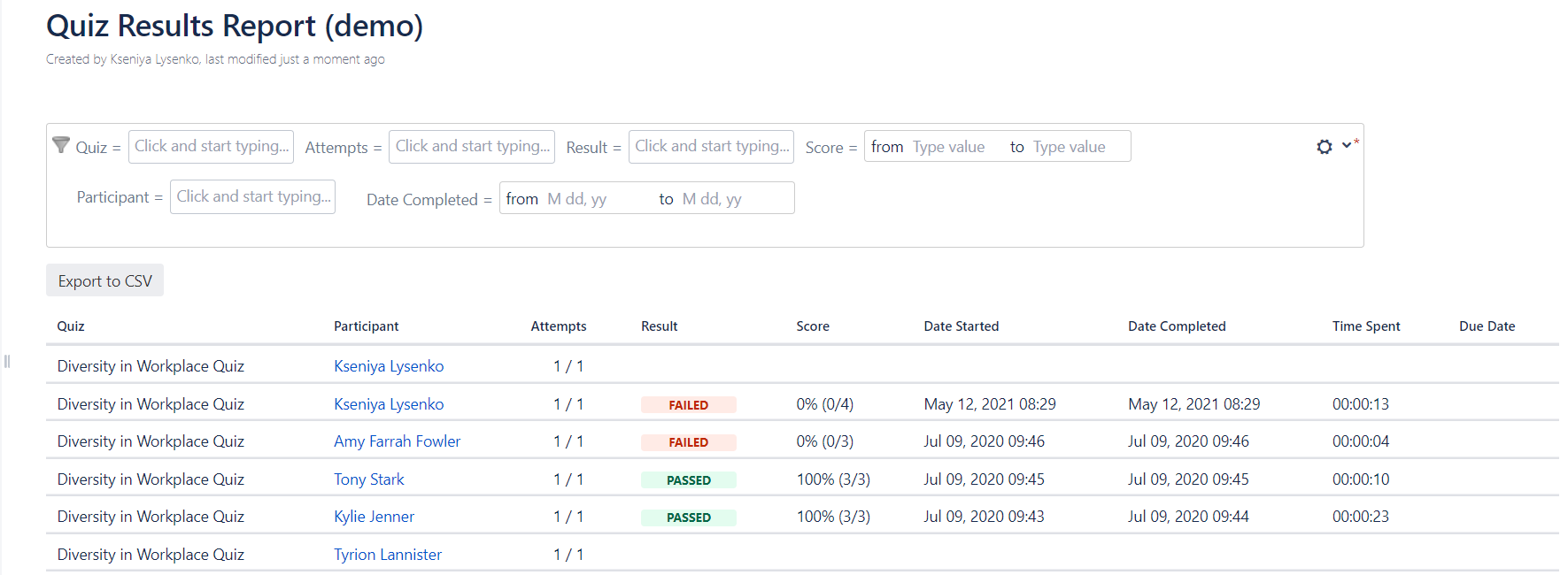
Quiz administrators can use the Quiz Results Report macro to build custom quiz reports based on their needs. For example:
all quizzes of a specific person – to track quizzes of a particular participant
all quizzes and all participants – to use it as a dashboard or global report
several quizzes – in case you have several connected quizzes and want to track them all in one place
Hint: To set up the results report of one particular quiz (e.g. to share it with participants), you can simply copy the report from a quiz administration page and paste it on another Confluence page.
Table Filter and Charts Macros
Table Filter and Charts works using three macros:
Table Filter – provides filters of different types
Pivot Table – summarizes table values
Chart from Table – visualizes table data with dynamic graphs and charts
Sample Quiz Results Report
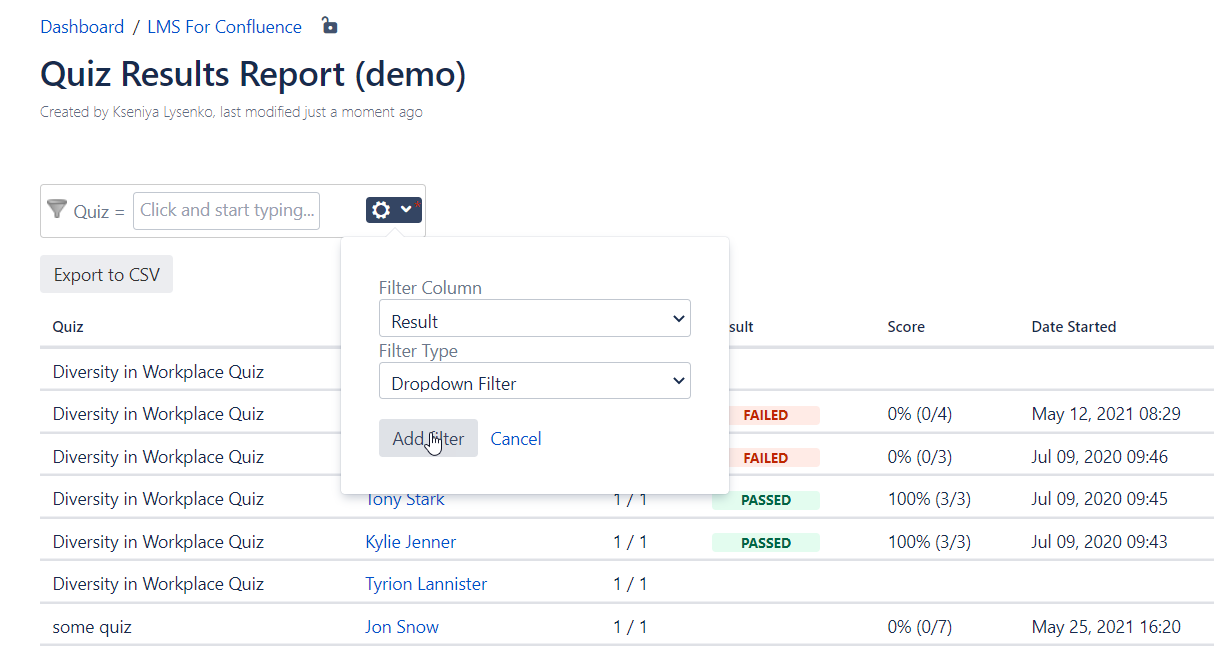
Dropdown Filter (for Status column) – to see participants who haven’t taken course/quiz yet, completed or overdue it.
Free Text Filter (for a column with a single choice question) – to learn what participants answered the question wrong (type the correct answer option in the filter and revert it)
Number Filter (for Score column) – to browse participants who had a score within a given range (enter from and to values in the filter)
Date Filter (for Date Started or Date Completed column) – to view course or quiz submissions for a certain time period (enter from and to values in the filter)
Hide Columns Filter – to dynamically collapse and expand columns of the report
Pivot Table
Count by Result – to see how many participants have failed and passed a course/quiz
Average of Score – to get the average score for a quiz
Chart from Table
Pie Chart by Status – to view the breakdown of courses and quizzes ( who Started/Not Started, Completed or Overdue).
Bar Chart by Question success rate – to see at a glance the questions with the lowest success rates (can be the most difficult or poorly written questions)
Average course progress of all participants in all courses.
Filter on Course status (completed, started, overdue)
Below are step-by-step examples of combining izi – LMS for Confluence and Table Filter and Charts. You can adjust them to create your own combinations.
Filter Report with All Quizzes and All Participants
3. Save the page – you can manage the pivot table in the View mode.
4. Select Count in Operation type, Status in Calculated column and Row labels.
5. Save changes.
6. Your pivot table is ready.
You can have a similar pivot table for Quiz Results Report. Just change values in Calculated column.
Hint: You can hide the source table (the report itself) and/or the control panel to only view the pivot table. It can be useful when your pivot table is located on a dashboard.
Combine Table Filter and Charts Macros to Empower Course Results Report
Reports used: Course Results Report based on a course.
Macros used:
Table Filter:Dropdown Filters forStatus, Resultscolumns; Free text Filter forUsercolumn; Number Filter for Score column; Hide Columns Filter for the whole report
Pivot Table: Count by Result
Chart form Table:Pie chart byResult
Steps:
Create a report based on some course.
Embed Course Results Report, Table Filter, Pivot Table, Chart from Table macros as shown below.
Save the page to continue in the View mode.
Set up filters in the report (See the ‘Filter Report with All Courses and All Participants’ section).
Generate a pivot table with Count by Result (See the ‘Summarize Report with All Quizzes of a Single Participant’ section).
Configure a pie chart – just select Pie in Type – the chart will be built from the pivot table.
Conclusion
Learning administrators can easily build custom reports suitable for their goals. Table Filter and Charts gives you powerful and easy-to-use tools to get the most out of tracking training in Confluence. Combining all 3 macros of Table Filter and Charts, you get filters, charts and pivot tables working together and dynamically updating as you change their settings.
In our postlast year we reviewed the most requested features for Atlassian Confluence, this year we decided to take a new look at them and see what has changed since that time.
At first, let’s remember Top 5 Most Requested Features for Confluence in 2015. That list looked as follows:
All the people who use AtlassianConfluence Server were waiting for the release of Confluence 6. Every major product version brings great changes for users. Confluence 6 was released with only one major feature, but this feature is very special. Collaborative editing became available for everyone. Let’s take a look at it.